There were two venues for this year’s Teagasc National Dairy Conference with big turnouts in both Clonmel and Cavan.
Milk price worries were the topic of the majority of conversations over the two days, with farmers visibly concerned about what 2026 holds in store for them. To open the conference, Chris Walkland a dairy market analyst from the UK presented via a live zoom link.
He discussed the reasoning behind recent price cuts and gave his outlook on future prices. Starting with the current prices, Chris gave several reasons for the drops but said the increases in milk production worldwide have been the big driver of lower demand.
“This year we seen a combination of better genetics and cheap feed combined for the first time really. This has caused a significant increase in production across the world. Coupled with this, there was the impending threat of tariffs from the US government in early 2025.
“Some Irish processors reacted to this by forward selling stock into the US market. The US stocks filled up and the demand for products dropped off” he said.
On the back of high prices other countries upped their output.
Big players like the US, France and Germany have continued to produce higher volumes of milk on previous years.
The price cuts experienced in Ireland and the UK have yet to reach these countries and until they do the market will be over-supplied according to Chris.
On a positive note, he said that when price falls, these nations tend to dry-off quickly and cull hard. That should see the market correct itself somewhat.
Looking forward, Chris predicted prices of 35c to 36c continuing into next year.
“It’s likely to be August or September before we see an uplift in prices again” he said.
Key Performance Indicators
Joe Patton, head of dairy knowledge transfer with Teagasc, analysed some of the key performance indicators on dairy farms over the last number of years and how they’ve changed.
“Costs of production began to increase since 2020 due to external factors like the Covid pandemic and the war in Ukraine. This has been compounded by the incremental increases in the level of purchased concentrate feed at farm level” he said.
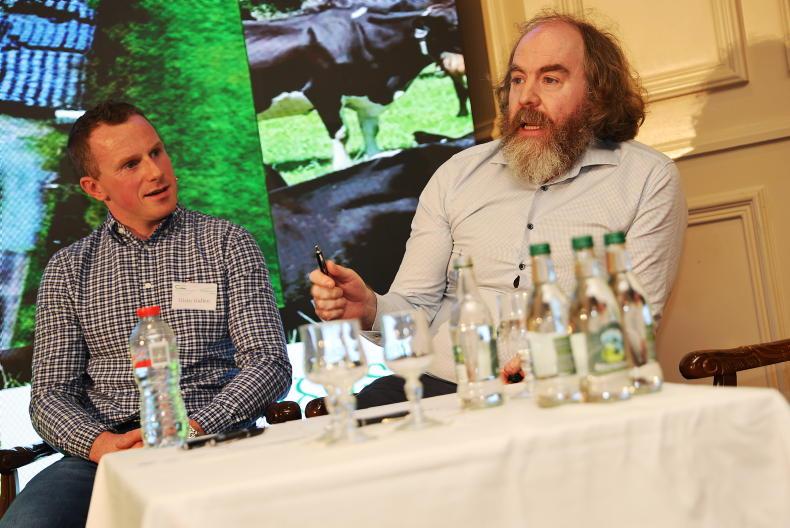
Oisin Gallen, farming in Donegal and Joe Patton, Teagasc, head of dairy knowledge transfer answer audience questions at the Teagasc National Dairy Conference in Co Cavan. \ Lorraine Teevan
Purchased feed is the biggest cost change on farms and it’s replacing grazed grass in cows’ diets was the key message. Grass utilisation is a very important metric of profitability for farms.
This is robust regardless of milk price according to Joe.
Better grass utilisation per hectare will result in a higher profit margin, if it’s done in the right way.
Many farms have increased stocking rates to utilise more grass in recent years. However, increasing stocking rate where there is not enough available grass, will lead to an increase in supplement required and higher costs of production.
“There is a balance to be found and this starts with assessing the available grass on the platform and matching stocking rate accordingly. Any gains in herd productivity must be driven from quality grass intake and better genetic performance. “There is no margin in the meal bin” Joe said.
Twenty-five years on from its inception and on the back of a 2025 update, EBI continues to deliver better genetics and profitability for Irish farms according to Donagh Berry, Teagasc researcher in genetics.
“High-EBI cows outperform other animals in terms of milk solids, fertility, survival and profitability across various production systems. Since the beginning of EBI, Irish cows are now potentially €380 more profitable per lactation” he said. One of the big talking points from this session was where the next generation of breeding bulls in the country is coming from.
“For me, this is a big worry. Sexed semen is an excellent technology but it’s creating something of a problem.
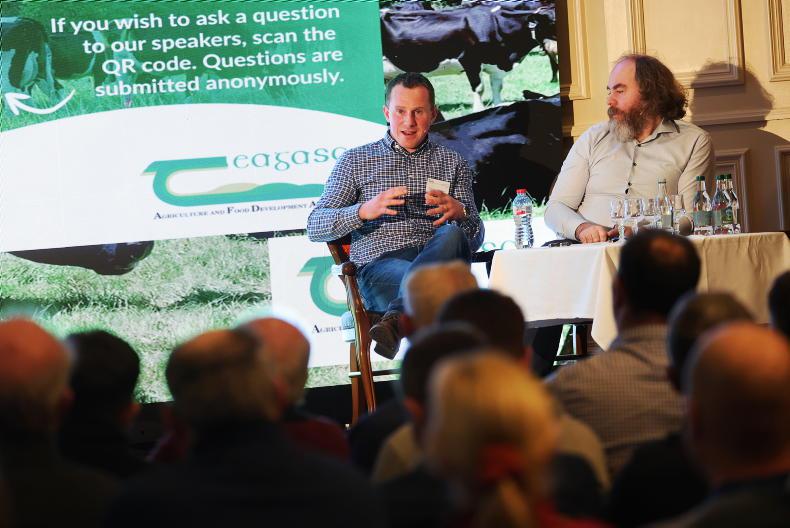
Oisin Gallen, farming in Donegal and Joe Patton, Head of dairy knowledge transfer at Teagasc, answering audience questions at the National Dairy Conference, Co Cavan / Lorraine Teevan
"The highest EBI cows in a herd, are now all being mated to sexed semen. These animals would previously have been used to breed high EBI bulls that go into AI stations” Donagh said.
“This is the national breeding programme built for the farmers themselves. So, what is it going to take for these farmers to mate five to ten of their best cows to outcross bulls who are unrelated to the population to produce the next generation of bulls?
"It’s a serious conversation that we need to start having to protect the future genetics of our herds” he continued.
With beef price high and sexed semen being used on most farms across the country, this is an issue that could continue to worsen unless action is taken.
With over 60% of Irish farmers now over the age of 55 according to Teagasc’s Ruth Fennell and Conor Hogan, the next generation are an essential consideration.
A topic that’s received a lot of air-time over the last couple of years, the whole area of succession and collaborative farming is one that will continue to remain firmly in the spotlight into the next decade.
On both days, there were examples of farmers at different ends of their journey, with presentations from both those who were stepping back and those who were stepping up.
In each of the four farmer examples, communication, trust and open-mindedness were key parts of the success stories.
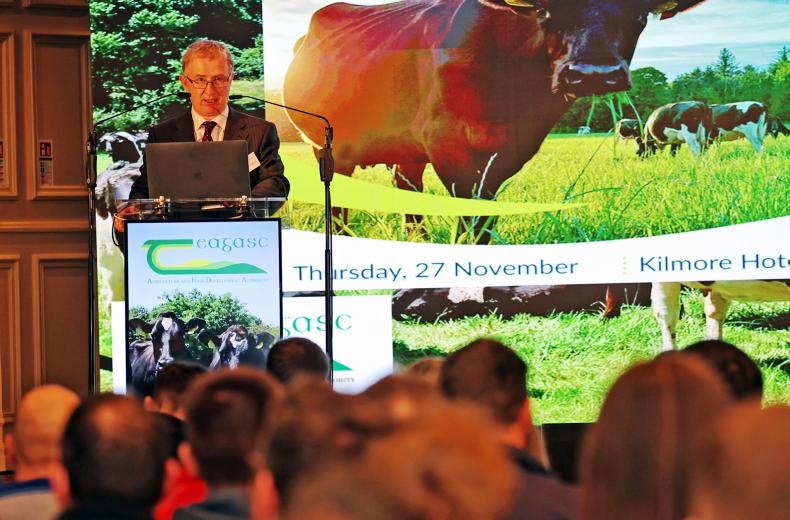
Frank O'Mara, Director of Teagasc addresses farmers at the Hotel Kilmore, Co Cavan to open the Teagasc National Dairy Conference. \ Lorraine Teevan
When it comes to collaborative farming, there are several options available to farmers looking to step back. Partnerships, share farming and leasing are the most common.
Before entering a collaborative arrangement, farmers were encouraged to get as much professional advice as possible. Every situation is different and it’s up to the individuals to decide what works for them.
As long as an arrangement is well-planned and technical farm performance is strong, any of the arrangements can deliver profitability for both parties.
In the final session of the conference, there were four brief presentations outlining some of Teagasc’s most recent research updates.
Water quality
As part of the Better Farming for Water programme, farmers were encouraged to think local and take voluntary measures to reduce their impact on water in their catchment area.
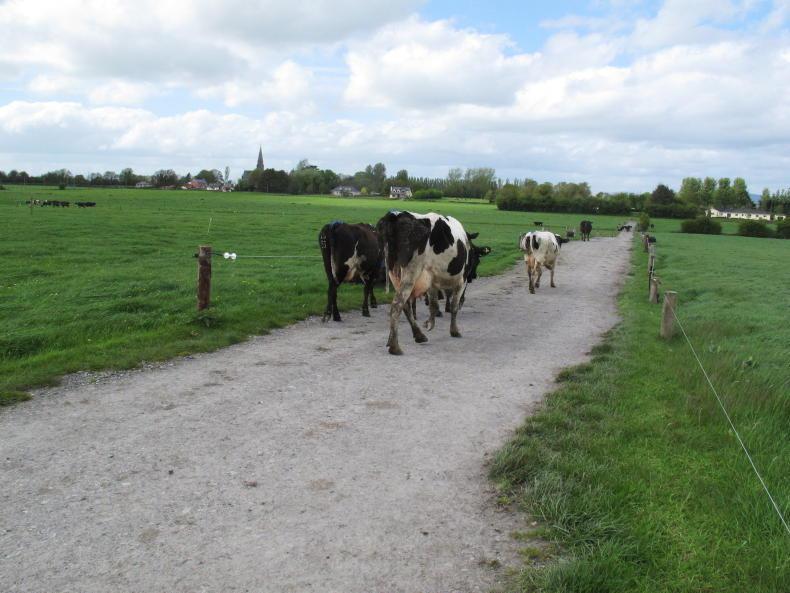
Farm roadways require maintenance and upkeep to limit runoff.
New roadways should be kept to the middle of the field and away from drains. Silage pits should be kept clean and tidy at all times. In terms of slurry storage, it’s essential that farmers monitor the level of water entering tanks and review how much more storage is required accordingly.
These simple steps can have a huge impact on a farm’s impact on water quality, the research shows.
Pasture Profit Index
The PPI (pasture profit index) ranks perennial ryegrass varieties based on economic merit and is a tool that should be used when reseeding. Like the EBI, the PPI underwent an update this year.
The updated index is now more reflective of current costs, for example the increase in the cost of reseeding. Teagasc had previously costed reseeding at €800/ha but this has risen to €1,100/ha in the updated index.
The update also now includes grass utilisation as an economic value, instead of the previous star rating that existed for comparing different species.
MoSt grass growth
prediction model
This model was developed to predict grass growth on farms across the country based on weather, soil type and nitrogen fertiliser application. The model has now been incorporated into Pasturebase Ireland which means more farms will be accurately simulated in the near future. Based on the model’s predictions, climate change will mean annual grass production in Ireland is likely to increase.
However, the seasonality of growth will change with more grass growth in both winter and spring with a decrease in summer growth.
Controlling costs
With production costs increasing on farms, Teagasc notes more farms need to track costs and benchmark against others. To help with this, they have developed a set of reference costs.
The reference costs quantify the usage rates for all farm inputs and each input has an accurate market price attached.
This allows any farmer to benchmark their costs off the reference model and therefore identify areas of strength and the areas for improvement in the business.
There were two venues for this year’s Teagasc National Dairy Conference with big turnouts in both Clonmel and Cavan.
Milk price worries were the topic of the majority of conversations over the two days, with farmers visibly concerned about what 2026 holds in store for them. To open the conference, Chris Walkland a dairy market analyst from the UK presented via a live zoom link.
He discussed the reasoning behind recent price cuts and gave his outlook on future prices. Starting with the current prices, Chris gave several reasons for the drops but said the increases in milk production worldwide have been the big driver of lower demand.
“This year we seen a combination of better genetics and cheap feed combined for the first time really. This has caused a significant increase in production across the world. Coupled with this, there was the impending threat of tariffs from the US government in early 2025.
“Some Irish processors reacted to this by forward selling stock into the US market. The US stocks filled up and the demand for products dropped off” he said.
On the back of high prices other countries upped their output.
Big players like the US, France and Germany have continued to produce higher volumes of milk on previous years.
The price cuts experienced in Ireland and the UK have yet to reach these countries and until they do the market will be over-supplied according to Chris.
On a positive note, he said that when price falls, these nations tend to dry-off quickly and cull hard. That should see the market correct itself somewhat.
Looking forward, Chris predicted prices of 35c to 36c continuing into next year.
“It’s likely to be August or September before we see an uplift in prices again” he said.
Key Performance Indicators
Joe Patton, head of dairy knowledge transfer with Teagasc, analysed some of the key performance indicators on dairy farms over the last number of years and how they’ve changed.
“Costs of production began to increase since 2020 due to external factors like the Covid pandemic and the war in Ukraine. This has been compounded by the incremental increases in the level of purchased concentrate feed at farm level” he said.
Oisin Gallen, farming in Donegal and Joe Patton, Teagasc, head of dairy knowledge transfer answer audience questions at the Teagasc National Dairy Conference in Co Cavan. \ Lorraine Teevan
Purchased feed is the biggest cost change on farms and it’s replacing grazed grass in cows’ diets was the key message. Grass utilisation is a very important metric of profitability for farms.
This is robust regardless of milk price according to Joe.
Better grass utilisation per hectare will result in a higher profit margin, if it’s done in the right way.
Many farms have increased stocking rates to utilise more grass in recent years. However, increasing stocking rate where there is not enough available grass, will lead to an increase in supplement required and higher costs of production.
“There is a balance to be found and this starts with assessing the available grass on the platform and matching stocking rate accordingly. Any gains in herd productivity must be driven from quality grass intake and better genetic performance. “There is no margin in the meal bin” Joe said.
Twenty-five years on from its inception and on the back of a 2025 update, EBI continues to deliver better genetics and profitability for Irish farms according to Donagh Berry, Teagasc researcher in genetics.
“High-EBI cows outperform other animals in terms of milk solids, fertility, survival and profitability across various production systems. Since the beginning of EBI, Irish cows are now potentially €380 more profitable per lactation” he said. One of the big talking points from this session was where the next generation of breeding bulls in the country is coming from.
“For me, this is a big worry. Sexed semen is an excellent technology but it’s creating something of a problem.
Oisin Gallen, farming in Donegal and Joe Patton, Head of dairy knowledge transfer at Teagasc, answering audience questions at the National Dairy Conference, Co Cavan / Lorraine Teevan
"The highest EBI cows in a herd, are now all being mated to sexed semen. These animals would previously have been used to breed high EBI bulls that go into AI stations” Donagh said.
“This is the national breeding programme built for the farmers themselves. So, what is it going to take for these farmers to mate five to ten of their best cows to outcross bulls who are unrelated to the population to produce the next generation of bulls?
"It’s a serious conversation that we need to start having to protect the future genetics of our herds” he continued.
With beef price high and sexed semen being used on most farms across the country, this is an issue that could continue to worsen unless action is taken.
With over 60% of Irish farmers now over the age of 55 according to Teagasc’s Ruth Fennell and Conor Hogan, the next generation are an essential consideration.
A topic that’s received a lot of air-time over the last couple of years, the whole area of succession and collaborative farming is one that will continue to remain firmly in the spotlight into the next decade.
On both days, there were examples of farmers at different ends of their journey, with presentations from both those who were stepping back and those who were stepping up.
In each of the four farmer examples, communication, trust and open-mindedness were key parts of the success stories.
Frank O'Mara, Director of Teagasc addresses farmers at the Hotel Kilmore, Co Cavan to open the Teagasc National Dairy Conference. \ Lorraine Teevan
When it comes to collaborative farming, there are several options available to farmers looking to step back. Partnerships, share farming and leasing are the most common.
Before entering a collaborative arrangement, farmers were encouraged to get as much professional advice as possible. Every situation is different and it’s up to the individuals to decide what works for them.
As long as an arrangement is well-planned and technical farm performance is strong, any of the arrangements can deliver profitability for both parties.
In the final session of the conference, there were four brief presentations outlining some of Teagasc’s most recent research updates.
Water quality
As part of the Better Farming for Water programme, farmers were encouraged to think local and take voluntary measures to reduce their impact on water in their catchment area.
Farm roadways require maintenance and upkeep to limit runoff.
New roadways should be kept to the middle of the field and away from drains. Silage pits should be kept clean and tidy at all times. In terms of slurry storage, it’s essential that farmers monitor the level of water entering tanks and review how much more storage is required accordingly.
These simple steps can have a huge impact on a farm’s impact on water quality, the research shows.
Pasture Profit Index
The PPI (pasture profit index) ranks perennial ryegrass varieties based on economic merit and is a tool that should be used when reseeding. Like the EBI, the PPI underwent an update this year.
The updated index is now more reflective of current costs, for example the increase in the cost of reseeding. Teagasc had previously costed reseeding at €800/ha but this has risen to €1,100/ha in the updated index.
The update also now includes grass utilisation as an economic value, instead of the previous star rating that existed for comparing different species.
MoSt grass growth
prediction model
This model was developed to predict grass growth on farms across the country based on weather, soil type and nitrogen fertiliser application. The model has now been incorporated into Pasturebase Ireland which means more farms will be accurately simulated in the near future. Based on the model’s predictions, climate change will mean annual grass production in Ireland is likely to increase.
However, the seasonality of growth will change with more grass growth in both winter and spring with a decrease in summer growth.
Controlling costs
With production costs increasing on farms, Teagasc notes more farms need to track costs and benchmark against others. To help with this, they have developed a set of reference costs.
The reference costs quantify the usage rates for all farm inputs and each input has an accurate market price attached.
This allows any farmer to benchmark their costs off the reference model and therefore identify areas of strength and the areas for improvement in the business.





SHARING OPTIONS