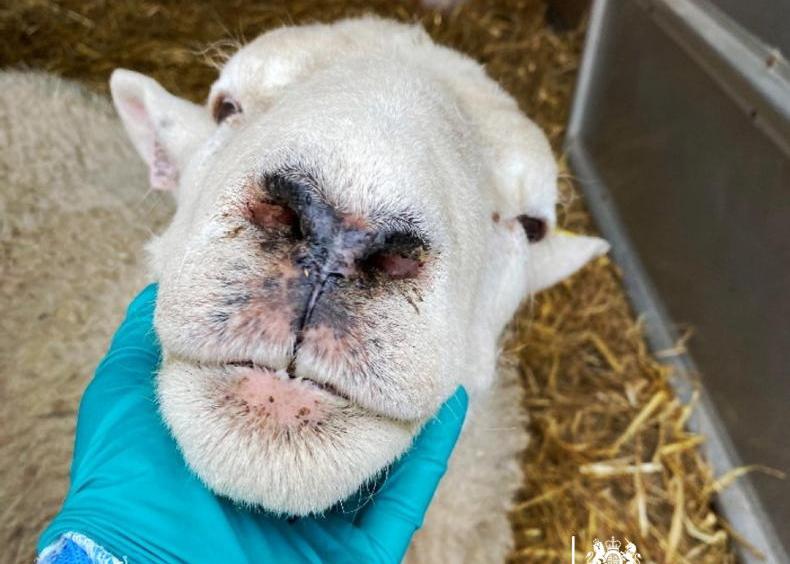
Bluetongue virus: This week’s news regarding the identification of bluetongue virus (BTV) in Co Down is an unwelcome announcement.
All stakeholders in the industry now need to work together to limit opportunities for the virus to spread. It is vital that any animals with suspect symptoms are brought to the attention of veterinary practitioners immediately.
Characteristic symptoms for sheep include ulcers or sores in the mouth and nose, along with possible swelling of the lips, tongue, head/neck or the coronary band of feet (along the hoof line), giving rise to lameness.
Discharge from the nose and eyes or drooling from the mouth is also common while some sheep can exhibit breathing problems. A fever also commonly occurs.
As highlighted in last week’s edition by Seamus Fagan, Athlone Regional Veterinary Laboratory, BTV can also cause abortion, foetal deformities and stillbirths. As such, any abortions should be sent for post-mortem, as should sheep that die from unexplained causes or show any suspect signs of the virus.
There are three vaccines approved for use in the UK, Bluevac – 3, Bultavo 3 and Syvazul BTV 3. The vaccines differ in their properties and those considering using them should consult their veterinary practitioner to determine the best course of action. An overview of these vaccines is available on www.farmersjournal.ie.
Ewe condition:
Grass supplies are diminishing at a rapid rate, with waterlogged soils and poor utilisation witnessing ewes getting half the grazing time that would be expected in many areas. Some flocks operating at a higher stocking rate have started housing ewes, while others have started supplementing forage at grass.
At a Teagasc sheep seminar in Cork this week, Michael Gottstein, Teagasc Head of sheep programme said that failing to take quick action and introduce supplementation where required will result in flesh cover falling off ewes.
This will prove very costly in the longer term, with a loss in ewe body condition nearly impossible to reverse as ewes enter late pregnancy.
Introducing supplementary feed now will represent a much lower cost than having to feed higher levels of concentrates in late pregnancy, not to mention the implications that poor body condition has on lamb birth weights, vigour, ewe colostrum yield and quality and overall mortality. This will be covered in detail in next week’s edition.
Clean livestock policy:
Compliance with the clean livestock policy has come back into the spotlight. As touched on in recent weeks, presenting sheep with a dry fleece could be the difference between animals being accepted or rejected for slaughter.
Where animals are being clipped to address dirty bellies pre-slaughter, it is important to clip the line from the tail right up to the top of the neck and not just the belly region.
For breeds with a long fleece it may be necessary to shear a few blows to prevent soiled wool falling down on incision lines. If in doubt talk to your agent or factory procurement before sending sheep for slaughter.
ACRES NPI deadline:
The deadline for farmers to submit payment claims for non-productive investments approved as part of 2023 annual works plans has been extended from 31 December 2025 to 31 March 2026.