


A day spent at Wageningen University is always a learning day. I was there recently as part of the Bayer Future of Farming event and it is always good to see research targeting future requirements and objectives. Wageningen is about 70km southeast of Amsterdam and it is a leading agricultural university with a global reach. It is very applied and a lot of its research targets problem-solving in conjunction with providing future solutions.
Professor Arthur Mol explained that research towards 2030 is targeting decreased food waste globally and increasing consumer trust in food production systems. As well as these, there are challenges associated with having enough food, sustainability for producers and an increased focus on bio-based production.
Professor Mol talked about the potential of new plant breeding techniques and the need to identify and refine new production spaces. These include areas such as aquaculture, the use of seaweed to help absorb phosphate from the sea, knowledge for food production in urban greenhouses (vertical farming) and the challenge of growing food in inhospitable environments such as deserts, the Arctic Circle and even Mars.
We saw work taking place on the automated measurement of bruising and other storage-related characteristics in apples. New, novel robotic and highly sensitive monitoring devices are being developed to assess individual fruits in high-capacity handling equipment.
We saw many instances of robot development, either as standalone functional tools or ones that interact with other measuring equipment. Phenomics was mentioned, which is the use of external sensors to guide automated devices which use artificial intelligence. There is increasing development of robotics for use in horticulture. And many of these capabilities are now being combined in the university’s autonomous greenhouse challenge project.

Automation is everywhere. We read about autonomous tractors and even autonomous fields where remote devices monitor growth and do the physical work. So it is hardly surprising that Wageningen is hosting an autonomous greenhouse challenge.
Applications came from 14 teams but these were cut to five. Teams comprised mainly of engineers, electronics and software people rather than horticulturalists. The specific crop to be grown was cucumber and all management and assessment had to be done remotely using artificial intelligence. One additional house was managed by a resident horticulturalist.
The teams fitted their individual houses with the equipment they deemed necessary in advance of planting. This included sensors, cameras etc. Harvesting was done manually by university staff and the projects are being assessed on production levels, resource use efficiency and overall cost and return. The project is ongoing but early indications favour automation.
A few weeks ago I reported on a project that was looking at the possibility of growing food in space and on Mars in particular. Wageningen has been heavily involved in many aspects of exploring the potential to produce food with minimal resources. International research has even identified how and where food production would be located on Mars should people arrive.
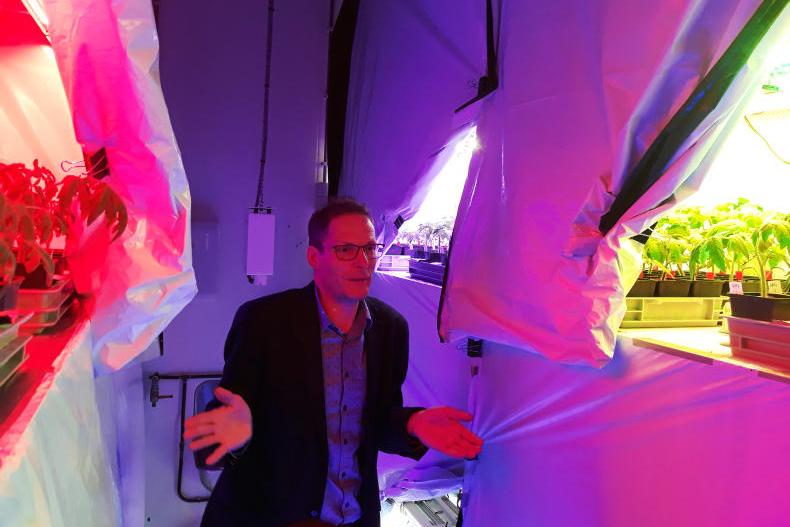
During the walk around Wageningen we met Prof Leo Marcelis, chair of horticulture and product physiology. He is working on a key area of plant growth we frequently forget about – light. The availability of low-energy LED lighting is leading to a lot of research in this area. While we generally see light as white, plants see it more for its constituent colours.
Leo had a number of light sources operating in growth chambers to learn about the purpose and characteristics of individual colours. This work has been going on for years in conjunction with Phillips lighting. Early work growing tomatoes in a glasshouse found that LED lighting reduced light energy requirement by over 40%. But this research also found an additional 30% energy saving by varying light colour and distribution.
Photosynthesis is the engine for plant growth. Everything begins there and the fuel used (type of light) influences the outcome. Photosynthesis can be altered by optimising light distribution, intensity and wavelength spectrum. Some glasshouse operators already use specific-colour LED light to alter the flavour of tomatoes and lighting has also been shown to increase vitamin C concentration in rocket.
Leo said we still have a relatively poor understanding of the effect of light on crop growth and performance. With different colours bringing different impacts, research continues to show the effects of light colour and timing and the effect individual colours have during different stages of growth. In this regard, he said we do not really know the consequences for growth of a red sky at night and if this is different to a red sky at morning.



SHARING OPTIONS