



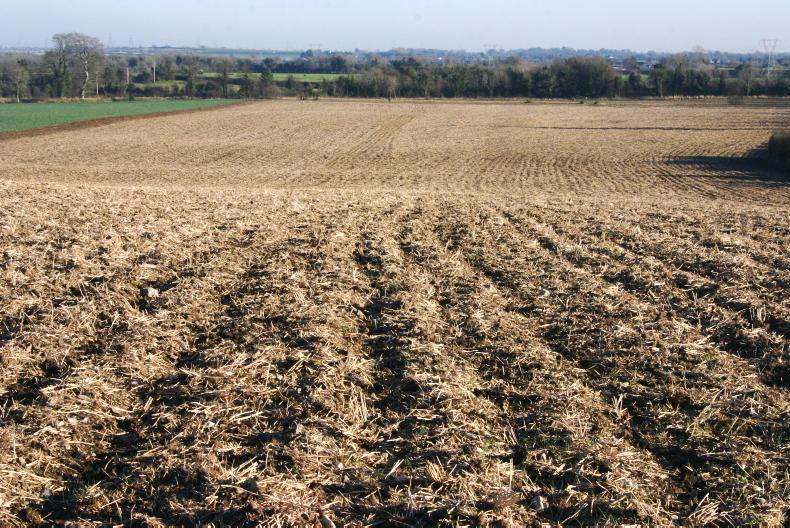
Stubble cultivation rules came in under nitrates rules in 2022.
They require tillage farmers to cultivate land after tillage crops to create a green cover to help to take up nitrogen left over in the soil.
Shallow cultivation is required, so farmers do not need to carry out deep cultivation.
Of course, tillage farmers already cultivated stubbles before this rule came in, but not as much as is required now and not in such a tight time frame, as these rules require the job to be done when farmers are already extremely busy.
Cultivation can be carried out with a disc, tine cultivator or a straw rake.
In many cases, green cover will start to form anyway from weeds that now have access to light and screenings or sometimes grain thrown out the back of the combine or fallen to the ground.
Where certain grass weeds are an issue the ground should not be cultivated, as they need to have light to germinate and be close to the top of the ground.
In order to get them to grow and control them, they need to be left alone. Rules allow these fields to be rolled.
Farmers with blackgrass, soft, meadow or rye brome should all avoid stubble cultivations where possible. You will need confirmation from an adviser that you have a weed issue. This ground can be rolled to encourage seed-to-soil contact.
What are the rules?
Cultivate stubbles within 10 days of baling or harvest and in all cases within 14 days of harvest.
You must cultivate if you are in Cork, Tipperary, Waterford and Leinster, apart from Longford.
You do not need to cultivate where crops are harvested after 15 September.
You should leave 20% to 25% of your total cereal stubble area uncultivated to provide a habitat for birds over the winter. The uncultivated area can include land destined for winter cereals that are not cultivated.
If farmers plant all winter cereal crops, they do not need to leave any area uncultivated.
Farmers can also plant catch crops under ACRES, Farming for Water or just plant of their own accord for grazing or otherwise and do not need to leave this land uncultivated.
They must also incorporate straw after chopping under the Straw Incorporation Measure. Any other cereal stubbles should be left uncultivated so that 20% to 25% of your cereal area has been left uncultivated.
When can farmers plough, cultivate or spray?
If you cultivate stubbles, then you can plough, cultivate or spray at the normal time of 1 December.
Uncultivated stubbles cannot be cultivated or sprayed until 1 February unless a crop is being sown straight into the field.
These rules put an awful lot of pressure on tillage farmers at an already busy time of the year. Do not put yourself under too much pressure to get this job done.
Birds
The rules take away an extremely important habitat for a number of endangered birds that depend on cereal stubbles for their habitat.
Research into its impact on endangered birds was announced after the rules' introduction and only started relatively recently. In the meantime, the impacts of the rules, which are expected to take away a habitat, are unknown.


SHARING OPTIONS