



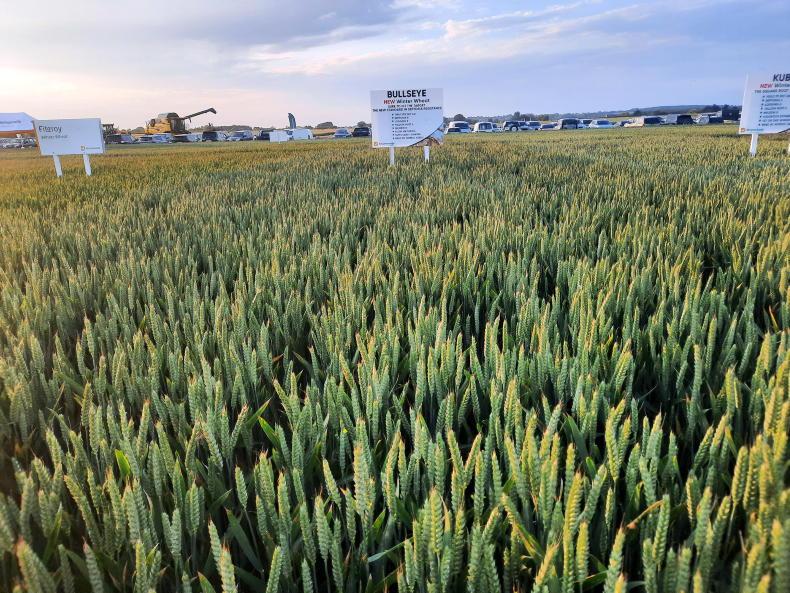
The winter wheat recommended list from the Department of Agriculture has received a major shakeup this year, as a massive six varieties have been added to the list for 2026, bringing the total number to 11 varieties.
Fitzroy is now fully recommended, while Torp is no longer on the list.
A number of these varieties still have small amounts of seed available. However, it is a promising sign to see so many provisionally recommended varieties beginning to fill what was a gap in strong varieties.
Relative yield scores are impressive. Kubik is the highest-yielding of the newcomers with a core of 107, matching Champion.
KWS Equipe, KWS Scope and LG Rebellion all follow with scores of 106. NOS Bullseye and RGT Hexton have scores of 102.
Spearhead is the only fully recommended variety higher than this at 104.
All varieties are relatively tall, with a range from 71cm to 80cm, lodging and breakdown are the traits to look out for on straw.
The varieties are generally very good on lodging. NOS Bullseye has a resistance to lodging score of eight, based on limited data.
A number of varieties score a seven, while Spearhead, Champion and KWS Equipe will require some extra attention with nutrition and growth regulators on a score of five.
Graham and KWS Equipe score a five on straw breakdown, so this is also something that requires increased attention with inputs.
There is a good mix of maturity across varieties, which is good for those sowing a large area of winter wheat.
KWS Equipe and LG Rebellion are the earliest ripening with a score of eight, followed by Graham and Kubik on a seven. Fitzroy comes in at a three and RGT Hexton has a score of four.
The lower scores on this might be best suited to early planting.
Disease resistance
Disease resistance scores are important for all crops, but winter wheat requires a lot of inputs.
In recent years, good septoria resistance has been lacking. Some stronger varieties are in the pipeline when it comes to septoria.
This year’s list has two varieties rated at a seven for resistance to septoria – Fitzroy and NOS Bullseye
This year’s list has two varieties rated at a seven for resistance to septoria – Fitzroy and NOS Bullseye.
In recent years, a score of six has been considered a high score for septoria resistance, but it is a poor enough score, so below a six means septoria control is even more difficult.
Mildew scores are generally good. Yellow rust was a disease that affected many crops this year in areas of the country that do not usually see rust.
KWS Dawsum leads the way on hectolitre weight or KPH of 78.1
Champion, KWS Scope and NOS Bullseye all fall down on yellow rust with a score of four, so early-season intervention will be essential with this variety where rust is a bigger threat.
Some parts of the south and western counties will have very few problems with rust, so this may not be an issue.
Fitzroy and LG Rebellion top the list for resistance to yellow rust.
There are a number of varieties susceptible to sprouting so they will need to be in fields more likely to be harvested early.
KWS Dawsum and KW Equipe score a seven for resistance to fusarium ear blight. There are a number of fives in the list, so keep an eye on them and a T3 would be advised on these crops.
Grain quality
There is very little in the difference in protein contents. Looking at thousand grain weight (TGW) and there are big differences between varieties.
NOS Bullseye has a massive TGW at 54.9, most varieties are at 51/52, while Kubik has the lowest TGW at 45.8.
KWS Dawsum leads the way on hectolitre weight or KPH of 78.1. Champion and RGT Hexton come in on the lower end of the scale at 74.9.


SHARING OPTIONS