


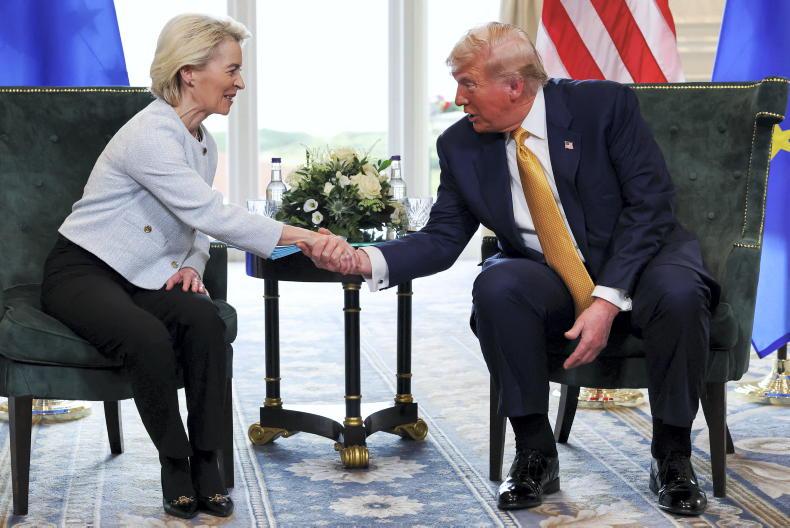
The ink was hardly dry on the framework agreement between the EU and the US on trade when courts in the US once again threw President Trump’s trade policies into question.
A US federal appeals court ruled that most of the tariffs introduced by Trump are illegal as they are an overreach of his emergency powers as president. In the case, which was about the so-called reciprocal tariffs which have been imposed on almost every nation the US trades with this year, the court found they are being illegally imposed.
The court said that the power to impose tariffs is the same as the power to impose tax, which under the US constitution is solely at the discretion of Congress, and not a power for the president, even under the emergency legislation Trump cited when announcing the tariffs.
Court
Unusually, the court did not immediately call an end to the collection of tariffs on imports to the US, but said they could remain in place until mid-October, which will allow time to challenge the decision at the US Supreme Court.
What this decision does is reignite the uncertainty over trade with the US which had started to calm down somewhat in recent weeks following the progress on trade deals.
Between now and the October 14 deadline, it is likely that the decision will cause a significant headwind for exporters to the US.
It is unlikely that American customers will be placing large orders at the moment if there is a chance the tariffs could be gone in six weeks. This will only serve to add further pressure to exporters who may have just started to re-engage with US customers following the US-EU agreement reached in the last few weeks.
On the agri-food side, the ruling should make little difference for butter sales to the US as the EU-US trade deal fixed the tariff paid on that product at the level which had always been paid under long-standing most-favoured-nation trade arrangements.
However, for products like whiskey where the US is a key market, the decision could come as another blow if customers delay orders when a boost might have been expected ahead of the important Christmas order season.
While the US Supreme Court has generally sided with Trump in major decisions recently, the outcome from this case remains in the balance.
Were the president to lose the appeal, then it would be a serious curtailment of his flagship international policy, and would almost certainly lead to fresh volatility as he inevitably tries to re-establish the tariffs under some other piece of presidential power.
On the other hand, were he to win, it would mean the Supreme Court would have confirmed the powers for the president which could further embolden him in future.
Once again, the only certainty about trade with the US is that further uncertainty is guaranteed.





SHARING OPTIONS