


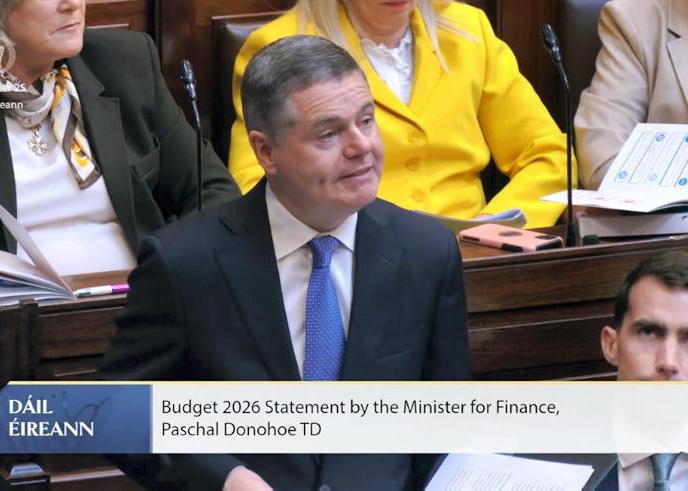
The 2026 budget has already secured a place in history – the history of Irish political lobbying. The accolade was conferred by columnist Seán Pollock in the Sunday Independent.
The most publicised budget give-away was the cut in the VAT rate on restaurants, previously 13.5%, reduced from next July to 9% at a heavy full-year cost, €680m.
Pollock documents the success of the campaign by the Restaurants Association of Ireland and its CEO Adrian Cummins, who deserves the rosette.
For the Government, and more especially the Fine Gael ministers most enthusiastic to help the restaurants according to Pollock, there will be no rosettes.
The failure to index bands and allowances for income tax payers has been blamed on the huge give-away to the restaurants, to include burger chains.
Overall the budget is expansionary, but that generosity has gone down badly, quite an achievement when the Irish Fiscal Advisory Council, the ESRI and the Central Bank are agreed that the economy is close to full employment so no stimulus was needed.
One anonymous official remarked that ‘they are trying to spend their way out of a boom’, using up fiscal space that might be better kept in reserve if a slowdown is on the cards.
The intention, now abandoned, had been to discontinue the 9% VAT rate altogether as it was introduced as a temporary cost-of-living measure in the face of the inflation surge a few years back.
With the decision to reprieve the rate, the number of VAT rates in Ireland will continue at no fewer than six, ranging from 23% down to zero.
The former is referred to as the standard rate, applies to a wide range of goods and services and raises most of the revenue from what is a very important tax gatherer, applying to all retail spending.
Along with income tax, the two payroll taxes (PRSI and the Universal Social Charge), and corporation tax, VAT raises serious revenue and the proliferation of rates is a political phenomenon, providing a seasonal temptation to politicians to play Santa Claus to some favoured group.
Designed
If there were a single rate of VAT on all retail purchases designed to raise the same revenue, that rate would be roughly 16%, saving lots of administrative overheads and taking the fun out of politics.
All restaurants will qualify but pubs and the accommodation sector are not so lucky.
The success of the VAT reduction lobby was built around the contention that many food outlets have been closing, but they always have.
Rural pubs have closed for reasons that have nothing to do with VAT and so have several pubs in Dublin.
Turnover in retail businesses, where entry and exit are relatively costless, are a fact of life.
Consumer trends are unforgiving – some hardware shops in my neighbourhood have thrown in the towel, beset by online competition.
The more expensive restaurants may not cut their prices at all, although competition at the cheaper end is more vigorous with many small outlets, so the bonanza for the big chains of burger joints may not materialise.
Differing
With so many differing VAT rates and the lobbying campaigns set to become an annual fixture given the success of the restaurants, the next big change might perversely be an increase.
If you fancy a meal out for that special person in a flashy restaurant in Dublin, with wine, it could cost you €100 or thereabouts, even at the 9% VAT rate.
This pays easily for a return flight to Paris, for two, with zero VAT on the airline tickets most days from now until the holidays, although the restaurant is extra. The reason is that airline tickets attract zero VAT, and there is no excise duty on jet fuel either.
Some countries, including the United Kingdom, have ticket taxes, a flat departure tax rather than VAT, but Ireland has none.
The generous treatment of civil aviation dates back to the Chicago convention of 1944, when there was very little civil aviation and Chicago was a safe place to hold a wartime get-together of airline chiefs.
In Ireland, restrictions on the use of the new runway at Dublin airport have been justified for all sorts of reasons including the discouragement of emissions.
Resisted
The world airline industry has successfully resisted the repeal of the Chicago convention and pursued instead the chimera of sustainable aviation fuels (made partly from recycled cooking oil) in the secure knowledge that it is not going to happen.
Airlines contribute between 3% and 4% of global emissions, not critical but why not discourage air travel by levying VAT at European level?
Trips to Paris hardly count as a necessity like basic foodstuffs, also zero-rated for VAT, and would not require flight restrictions on a fine new runway already built and paid for.



SHARING OPTIONS