



Biogenic methane (methane produced by animals and plants) is one of the predominant greenhouse gas (GHG) emissions emitted from global agricultural, the majority of which originates from ruminant livestock as enteric or manure methane.
In the Environmental Protection Agency's (EPA) national inventory report for 2022, 74% of Irish agricultural GHG emissions were attributed to methane associated with ruminant livestock production – 65% from methane produced by the rumen of cattle and sheep and a further 9% from methane associated with the storage of manure and slurry from ruminants, as well as pigs.
As a result, reducing the volume of methane produced by ruminant livestock will be critical to achieving the agricultural sector's 2030 GHG emissions reduction target.
Although breeding animals which emit less methane is a long-term strategy, research is well under way at Teagasc Grange to identify genetics which produce less methane.
At BEEF 2026, some of the research to date was presented, showing that there may be potential to reduce methane emissions in livestock through breeding.
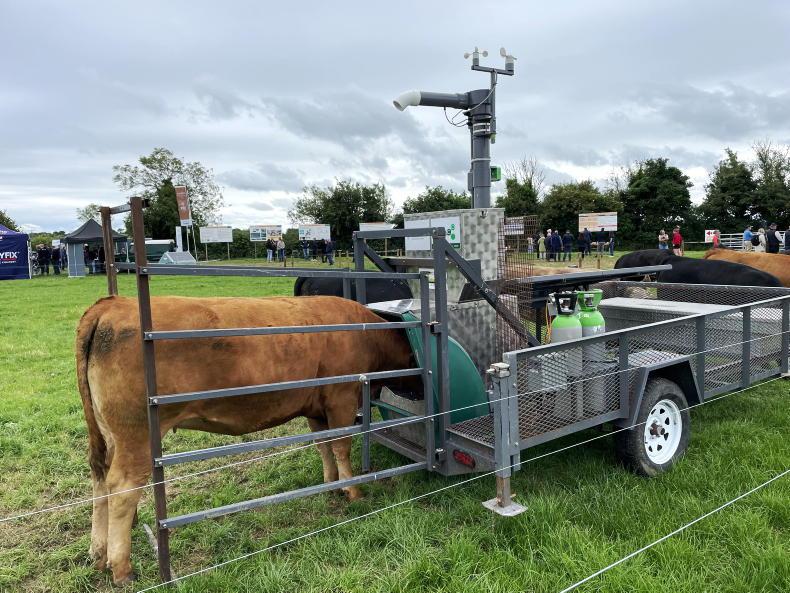
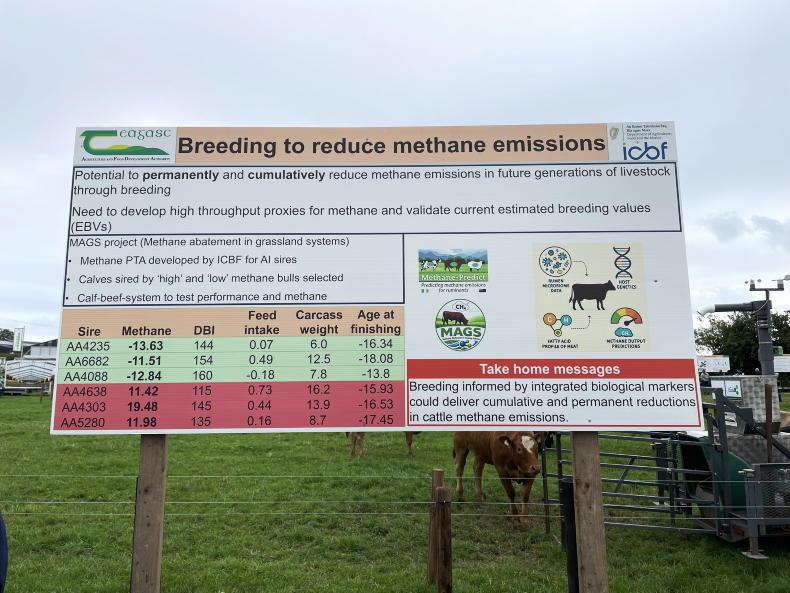
Using the recently published methane breeding values generated by the Irish Cattle Breeding Federation (ICBF), six Angus AI sires with greatest divergence in methane production and high reliability were selected.
Fifteen calves from each sire (from predominantly Holstein Friesian dams) were purchased from commercial farms this spring and they are now part of a 22- to 23-month calf-to-beef production system, where their feed intake, performance, methane emissions and carcase yield will be measured.
Based on their PTAs, sires with low methane output do tend to have a higher dairy beef index (DBI), lower feed intake and lower carcase weights on average – whether this will carry through to the progeny will be an important finding of the experiment.
As part of the study, half of the ‘low’ and half of the ‘high’ methane calves will be fed a high oil concentrate (proven to reduce enteric methane production) at pasture and during the winter periods, to see if a low methane diet is equally as effective in animals that have genetically lower methane emissions - ie, to see if there is a genotype by diet interaction.
The study, which begun this spring, is ongoing and will continue for the next 18 to 20 months.



SHARING OPTIONS