



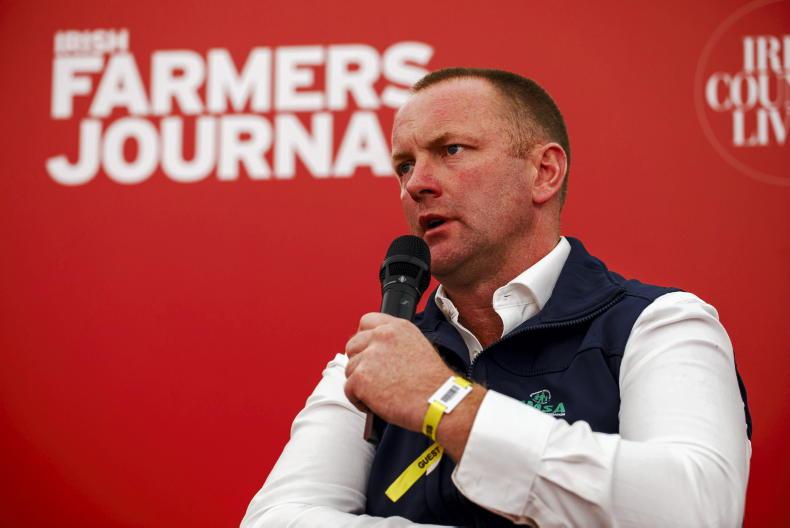
The Irish Creamery Milk Suppliers’ Association (ICMSA) has accused the Department of Finance-chaired Tax Strategy Group as having set its pre-Budget 2026 examination of a farm income volatility tool up for failure.
The tax group is not a decision-making body, but it does outline to Government the “various options for tax policy changes” it can consider ahead of each annual budget.
Some 22 pages in Budget 2026’s papers detail the group’s assessment of a farm income volatility tool that would allow farmers to defer 5% of their income in higher-income years to draw down in lower income years, when the revenue would be taxed.
An income volatility measure that would allow farmers defer a portion of their income in ‘good’ years to draw it down during difficult years has long been sought by farming organisations in a bid to stabilise incomes in a sector fraught with financial uncertainty.
The tax group assessed whether such a tool “could be held or managed” by co-ops, but it stated that this “gives rise to certain difficulties in relation to oversight” of any funds deposited.
ICMSA president Denis Drennan claimed that “nobody ever mentioned” designing the tool in a way that would see co-ops – rather than pillar banks or State bodies – being the entities that hold set aside income.
Drennan criticised the group’s decision to analyse deferring 5% of gross income as part of its assessment of the proposal.
“It looks like this 5% was chosen as a figure to show that income averaging is sufficient and that another tool is not needed,” Drennan told the Irish Farmers Journal.
“This is just a red herring. It was doomed to fail and it appears like the figure was chosen on purpose for this reason.
“With swings in volatility that could see incomes swinging 90% down or 113% up, 5% would be nowhere near high enough. You would have to be able to defer 30% or 40% to actually make it work.”
Tax measure
Drennan further dismissed the idea that there is “no evidence that a new tax measure would be more appropriate than the existing income averaging measure”.
He said that 41% of Australian farmers are availing of an income volatility tool while just around 5% of Irish farmers avail of income averaging and this calls into question the group’s claims.
The group also stated that a “lack of liquidity and financial knowledge” could see income deferment only benefiting older farmers and not younger farmers or new entrants.
However, the ICMSA leader said that the income averaging requirement of a few years’ worth of income tax returns before the measure can be availed of already rules many young farmers out at a time when they are looking to secure mortgages.




SHARING OPTIONS