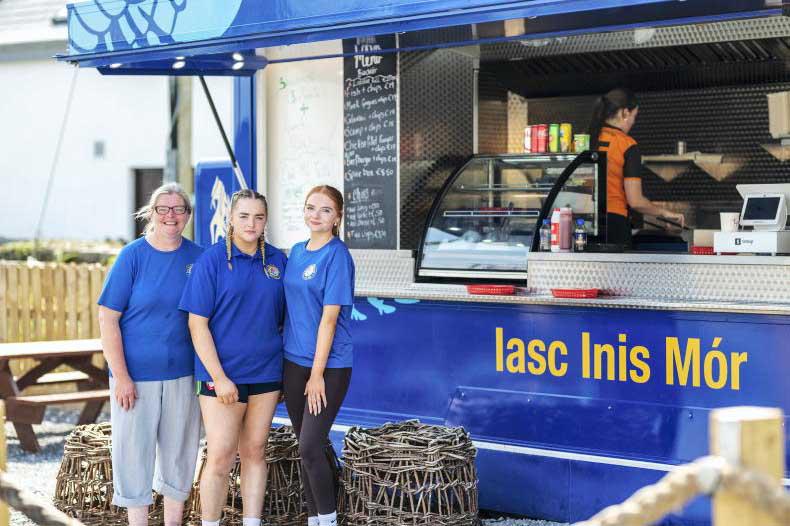
Niamh Donohue doesn’t have much time to chat. Neither does her husband, Bertie, nor their six children, Peter (26), Katie (21), Eimear (19), Nessa (17) and twins Maeve and Bertie (16). Inis Mór natives, a fishing family and – for the past three years – food entrepreneurs, July is one of their busiest months as they provide fresh seafood and warm island hospitality to daily boatloads of visitors.
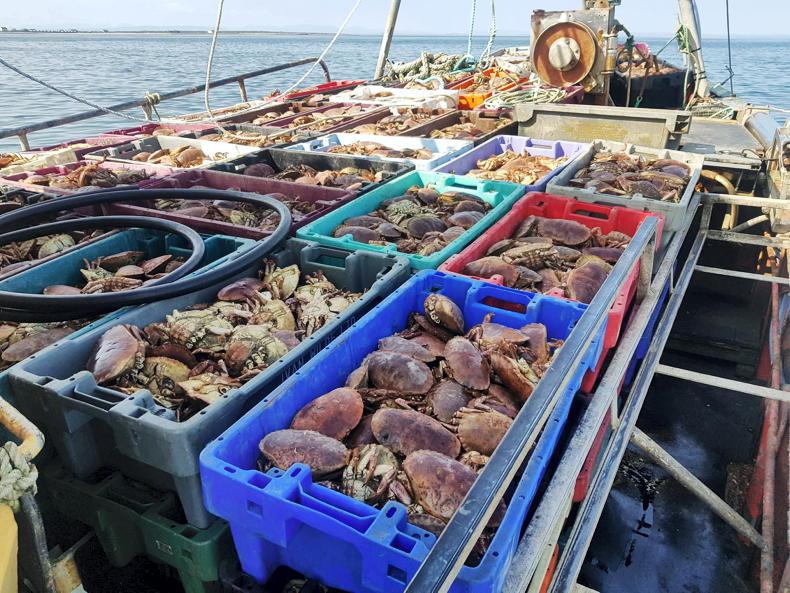
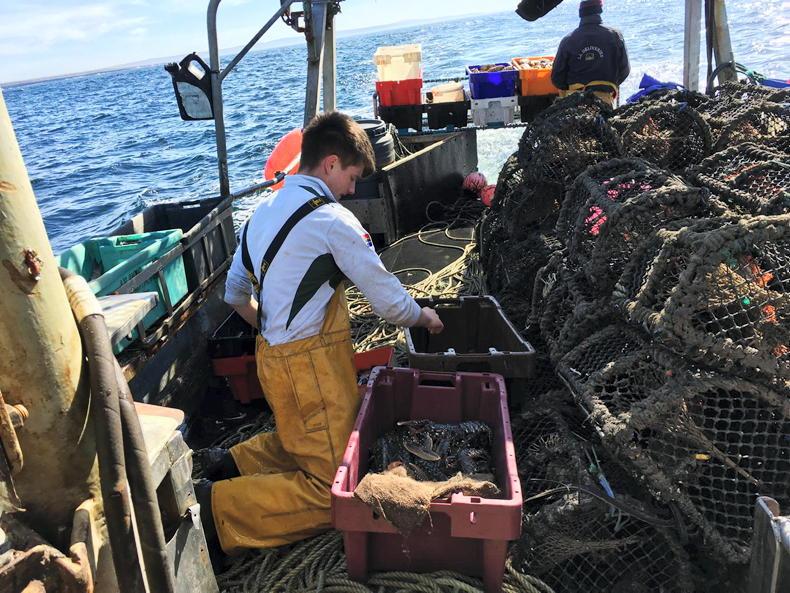
Their business, Aran Island Seafoods (@aranislandseafoods on Instagram), offers a unique sea-to-plate experience. Each day, Bertie heads out in his boat to catch fresh lobster and crab, which is processed in their fully licensed unit before being prepared and sold from one of their three food trucks. The original truck is at a popular tourist destination in Kilmurvey, which has been joined by a second one near their home in Killeany, and the third in Kilronan, where the ferry comes in to dock.
“Bertie has fished all his life,” Niamh says. “For years, he fished with his brother on a bigger boat. He’d be at sea for weeks at a time. When we had kids, it became tougher, him being away for long stretches. He started focusing on inshore fishing, then – crab and lobster – and that’s how all of this got started.
“Originally, we used to sell it wholesale,” she continues. “Then, in 2020, the prices weren’t great and it was becoming more difficult to sell, so we decided to cut out the middleman and process the seafood ourselves. In 2023, we said we’d try out the idea of a food truck, and it just took off.”
On Inis Mór, fishing and tourism are important sources of income, and everyone pitches in during the busy season. When Niamh opened her first food truck in Kilmurvey three years ago, she and her older daughters did everything, from cooking seafood to frying chips and serving customers. This year, Niamh is managing a staff of 10 over their three locations.
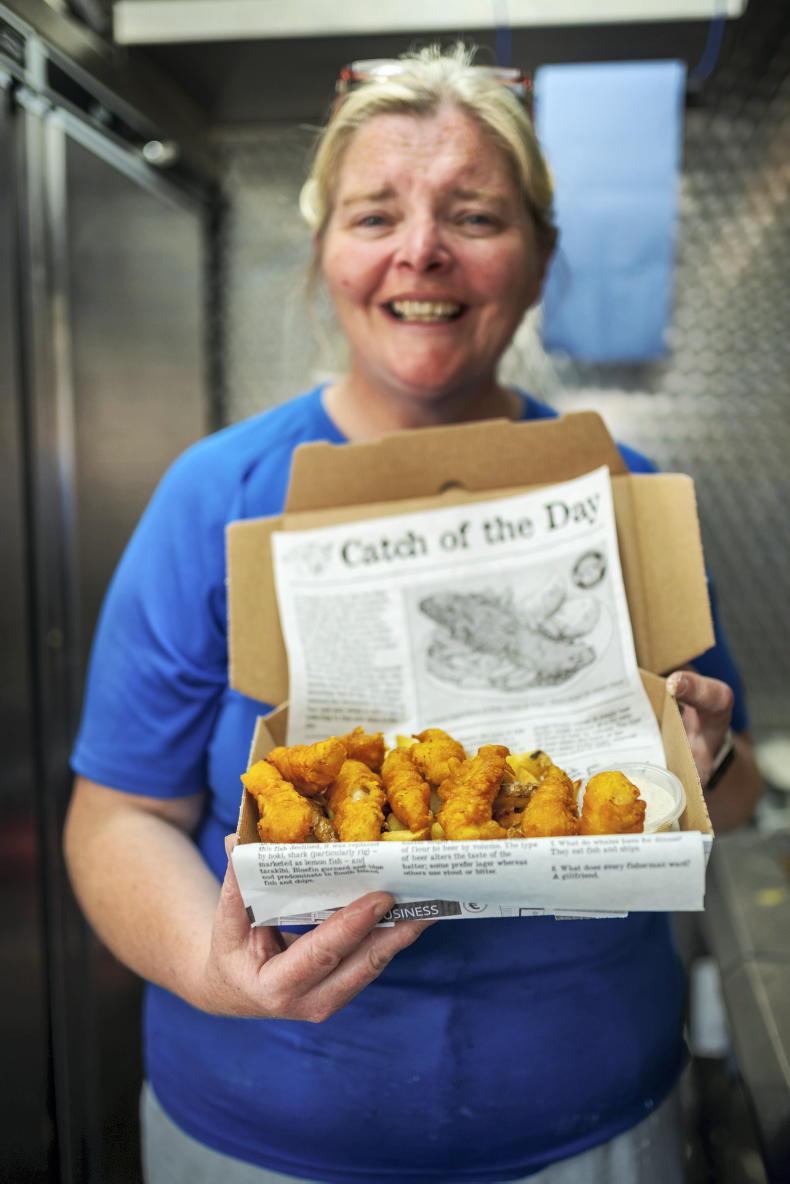
Their menu items are just what you’d want from a seafood-focused food truck – lobster and crab rolls, lightly dressed and served in soft, toasted buns, chunky chips which are freshly fried, and fish served in a crisp batter.
In many ways, Aran Island Seafoods was a business borne of necessity – the family needed to ensure their fishing enterprise was profitable and provided a secure future. Coming from such a practical base, Niamh says the personal pride she has felt since its inception has nearly taken her by surprise.
“It’s a really wonderful feeling, selling your own product,” she says. “Of course, you have to be getting some kind of gain out of it, and you’re starting out, really, just trying to get your kids through college. But then you start reading all of these lovely reviews and you think, ‘Wow.’ I’m really quite proud of how it’s taken off. Especially when someone tells you, ‘That was the nicest lobster roll I’ve ever had.’”
Award-winning sustainability
The Irish inshore fishery is mainly comprised of small, family-owned day boats like Bertie and Niamh’s. Lobster and crab are caught with sustainability in mind, because when you’re a fishing family, just like an Irish farming family, you are always thinking about what might – or might not – be there for the next generation.
“Fishing goes back generations in Bertie’s family,” Niamh says. “That’s all we had here, even during the Famine, that’s how we survived – we had the fish. And it makes sense: you’re on an island in the Atlantic; fishing is going to be one of the main ways of survival.
“It’s not as much anymore, because of bigger boats [coming from other countries], though, and you’d worry about that in the years to come.”
This past May, Niamh and Bertie were honoured with the Euro-Toques Ireland Food Award in the WATER category for their innovative approach to fresh seafood and all three pillars of sustainability: environmental, social and economic.
“This year’s award goes to Aran Island Seafoods, a remarkable family-run business rooted in the traditions and rhythms of island life on Inis Mór…,” the organisation shared at the time. “Aran Island Seafoods embodies the resilience of Ireland’s coastal communities and the enduring value of small-scale fishing traditions. This is seafood shaped by place, family and a profound respect for the sea.”
As Niamh speaks with Irish Country Living, her commitment to social sustainability is evident – she is in a hurry to finish our conversation because she needs to bring an order of fresh seafood to the local senior’s home.
“We take an order to the senior’s home once a month, on a Sunday,” she explains hurriedly, but with a smile. “They like their crab rolls and their fish and chips, just like the rest of us.
“Our work is very social,” she adds. “You meet a lot of people and often end up talking for ages. It’s seasonal, though, and it gets quieter each year from October. You need to make hay while the sun shines.
“Our location in Killeany was supposed to just be a prep kitchen, but the locals said, ‘There’s nothing on this side of the island, would you not open one here?’ So, we keep that location open year-round for the locals.”
In rare instances, strangely coloured lobsters are found in bright shades of orange, white and powder blue. The orange lobsters look as if they have already been cooked! BIM will be publishing a comprehensive picture of the Irish inshore fishing sector in the coming months, which will look at what we are catching, where and how.
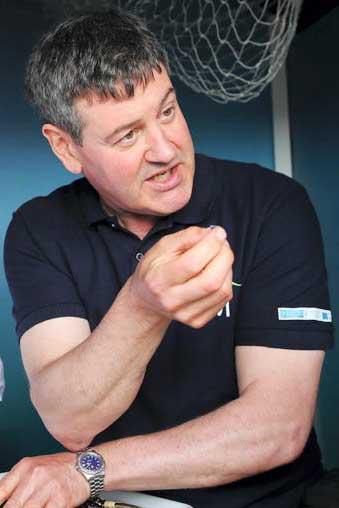
Lobster makes up a significant percentage of Ireland’s inshore fishery, according to Ian Lawlor, who is the development manager at Bord Iascaigh Mhara (BIM), Ireland’s seafood development agency.
“Lobster is fished all around the Irish coast,” he explains. “[It] is primarily fished by approximately 900 vessels, less than 12m in length, using baited pots, usually within a few kilometres of the shore.”
There are many reasons why we should enjoy more lobster in Ireland, but an important one is knowing that it is a sustainable choice at a time when many consumers aren’t sure where their seafood is coming from, or if it’s been sustainably sourced.
“As the lobster are caught using pots this means that young lobsters can be immediately returned to the sea to grow,” Ian says. “The stock is protected by a maximum and a minimum size, and also by a prohibition on the landing or sale of v-notched lobsters. There is certainly scope for more lobster to be eaten here in Ireland; the majority of the catch is exported live to continental Europe.”
V-notching
V-notching protects breeding female lobsters to help ensure there is continued stock for the future. It involves cutting a v-shaped notch out of the tail of breeding female lobsters before throwing them back to sea. This v-notch is a visible sign to other fishers, who will also know to throw that lobster back into the sea.
“V-notching has been widely successful and really is a good news story,” Ian says. “If caught again, v-notched lobsters cannot be retained or offered for sale. Lobsters with such marks have been protected by national legislation in Ireland since 1995.
“Each time a female lobster spawns, approximately 2,500 larvae are released into the water where they swim and grow for about three weeks before dropping to the seabed to hide among the rocks. As the female lobsters grow, the intention is that if they are v-notched a number of times [usually due to fishermen re-notching when they see the notch growing out], they will reach the maximum size of 127mm and be permanently protected.”
Fishers keep the piece of tail they cut from the lobster and are subsidised for the number they throw back over the year. Niamh and Bertie partake in the programme and say it feels good to contribute to the preservation of Irish lobster.
“For years, we’ve been putting a notch on the female lobsters,” she explains. “It’s a great thing to do, and you get paid for the little chip of the tail you keep. Coming up to Christmas, it’s a nice little bonus.”
In 2025, the BIM V-notching scheme saw a record total of 61,000 lobsters being v-notched and participation in the scheme was at an all-time high. The total notched will see an additional 457.5 million eggs available to contribute to the sustainability of the stock. This scheme is supported by the Government of Ireland and the European Union, under the European Maritime, Fisheries and Aquaculture Fund.
See bim.ie