



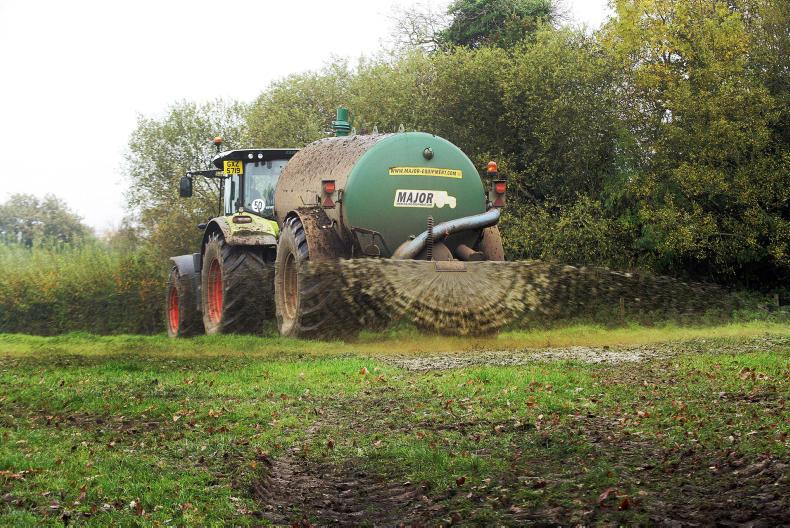
Very heavy rain over the last 24 hours has put paid to any hope of getting slurry spread, particularly for the early part of the week. This is putting extra pressure on already bulging slurry tanks.
Where there is slurry capacity, farmers should hold off on spreading slurry until ground and weather conditions improve. Where tanks are full, target dry fields and fields with low grass covers.
In a perfect world, you would like to be spreading around 30% of the farm with slurry in early spring. For every 1,000 gallons of slurry spread per acre, there are approximately five units of nitrogen available to the grass plant.
So spreading 3,000 gallons/acre of slurry is equivalent to spreading 15 units/acre of urea.
Ideally, the paddocks for slurry will have low grass covers (ideally less than 500kg/ha) and won’t be grazed for about six weeks after spreading to avoid any contamination of slurry affecting grass intakes.
Where grass covers are higher and you have no option but to spread on that field, then consider spreading with a trailing shoe or an injector. These methods will reduce the risk of slurry contaminating pasture.
However, there are no nitrogen-use efficiency benefits to using an injector or trailing shoe instead of a splash plate in early spring. As spreading with these methods is more expensive than a splash plate, they should only be used when spreading in high covers.
While land is too wet to graze in most parts, another use of slurry over the next month is on fields that have been grazed. Ideally, 30% of the farm should be grazed in February and slurry should be spread on this land after grazing.
Now is the time to order nitrogen if not already done so. There should be 70 units/acre of nitrogen spread before the end of March between slurry and chemical fertiliser. Urea is the product of choice in spring.




SHARING OPTIONS