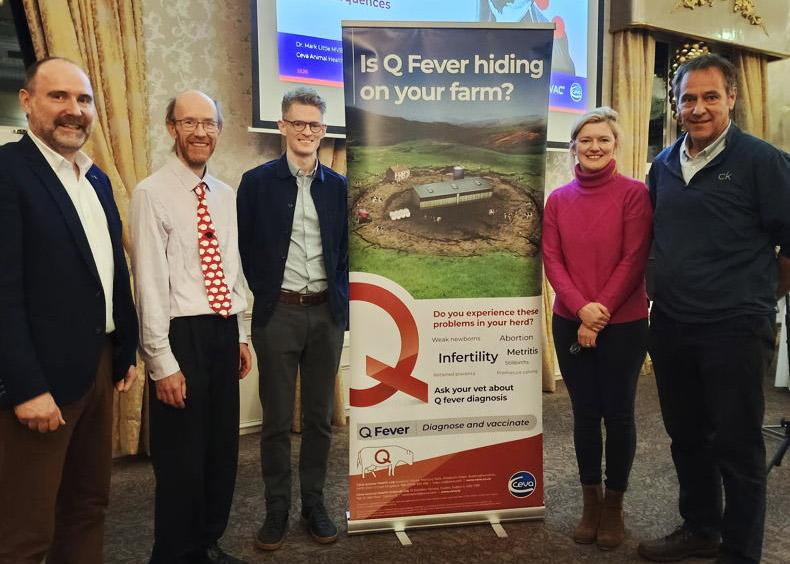
Local vets are increasingly aware of the threat posed by query fever (Q fever), although it remains an infectious disease largely hidden away on farms.
Addressing an autumn meeting of the NI Agri-Rural Health Forum held at the Corrick House Hotel outside Clogher, Dr Mark Little from pharmaceutical company Ceva, said it can be a disease that causes “subtle” underperformance in livestock.
He quoted data which shows cows positive for Q fever are 2.5 times more likely to abort, 1.5 times more likely to hold a cleaning after calving, 2.5 times more at risk of endometritis/metritis (whites) and four times more likely to suffer early pregnancy loss. Calving to conception interval is 14 days longer. Milk yield and milk solids are reduced.
“These are herds and flocks where we know something is not quite right, but we can’t put our finger on it,” said Little.
Analysis from France puts Q fever as the second most common cause of abortion in cows after neospora and it is also rated second in sheep after toxoplasmosis. Closer to home, the all-Ireland disease surveillance report ranks Q fever as the second most common bacterial cause of abortion in cattle. However, there are no labs in NI testing for Q fever, so any samples are usually sent to the Republic of Ireland.
Cause
Q fever is caused by the bacteria Coxiella burnetii, which is found in farm animals including, cattle, sheep, and goats.
According to Little, it is a “very clever bacteria”, which can be shed by carrier animals that are healthy and which might shed bacteria one day and not the next.
It can survive in dust, faeces or soil, is resistant to drying out and really stable in the environment. “You can’t disinfect or steam-clean your way out of it,” said Little.
Spread can also be due to bacteria being blown in on the wind, although the main route of infection tends to be via the inhalation of contaminated air particles after a high bacterial load has been released in birth fluids.
Because infected animals might not show any clinical signs, the best way to check if there is infection in the herd is via a bulk milk sample, although it probably needs to be done two or three times, to get an accurate picture, said Little. The alternative is to get a vet to send off samples from aborted material for testing.
Control
Where an infected animal is identified, there is little point treating it with antibiotics. “The bacteria survive in cells in the immune function, so you would have to give antibiotics until all those cells are replaced – that takes a long period of time, months – it is not feasible in animals,” said Little.
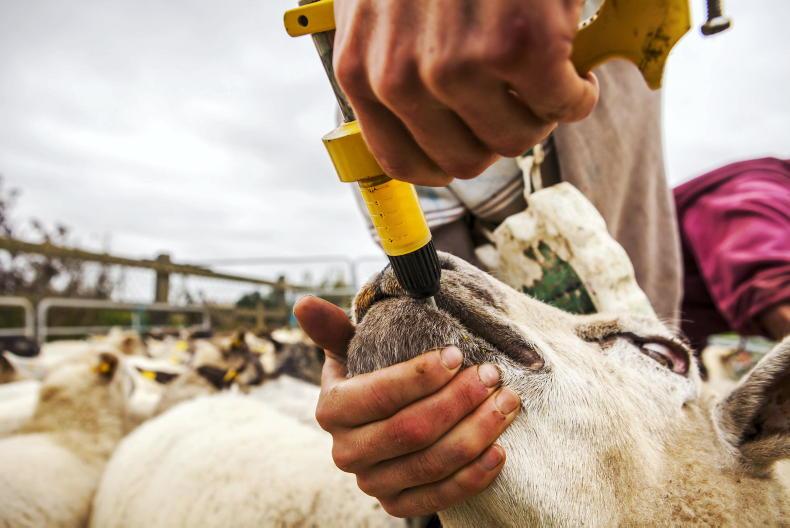
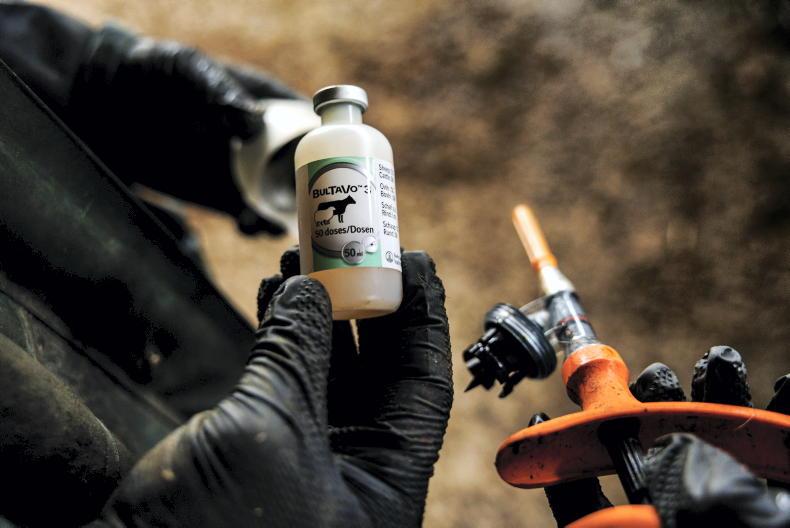
Instead, he said the best way to control it is to vaccinate and help to prevent healthy animals getting infected. There is a Ceva vaccine available (Coxevac), which requires two shots to be given, three weeks apart, followed by an annual booster.
There are a few herds in NI now vaccinating against the disease because they had abortion and/or fertility issues, and had identified Q fever as being present.
“If you don’t have a problem, I wouldn’t go looking for Q fever. These herds are vaccinating for a reason and they don’t stop, because they have seen a difference,” said Little.
A zoonotic and notifiable disease
Q fever is a zoonotic disease, which means it can pass to humans, with farmers, farm families and vets all at risk.
Analysis suggests that around 60% of the time the body’s immune function fights off the bacteria, but in remaining cases, people will develop flu-like symptoms, which can become chronic infections and, in a small number of cases, end up requiring hospitalisation. In a chronic case, the person might need to take antibiotics for many months.
Data from the Republic of Ireland shows that about five people every year develop serious complications, so it is a small number, said Little.
However, there have been some large-scale outbreaks reported in the human population, particularly in the Netherlands between 2007 and 2010.
Over 4,000 cases were notified, with almost 750 hospitalised and nine initial deaths – there were 107 deaths up to 2022 associated with the outbreak.
The Dutch outbreak was linked to nearby goat farms and these herds must now vaccinate their animals, said Little.
In the UK
There have also been outbreaks in the UK, including outside Birmingham in the late 1980s, which affected 147 people, and around Cheltenham in 2007 which was associated with 30 human cases.
Investigations identified wind-borne infection from farms as the cause.
Because Q fever can pass from animals to humans, any positive cases must be notified to DAERA.
However, that is only for surveillance purposes in the event of any human cases.
“It will not result in the farm being shut down or any movement restrictions. Mandatory surveillance is compulsory EU wide,” confirmed Little.
Q fever prevalent in Irish dairy herds
A study led by Dr Katie Corridan from University College Dublin, published in 2026, has identified a relatively high exposure rate to Q fever within the Irish dairy herd.
Across 2,687 herds, Q fever antibodies were found in 61.7% of bulk tank milk samples collected as part of the research.
The next part of the study is to try to understand how many people have come into contact with the infection, with blood samples taken from those who work with animals (farmers and vets) and compared against those who don’t.
Profile
Given that most herds in the Republic of Ireland are spring calving, there is potentially a greater risk of Q fever spread due to the large numbers of cows being calved at the same time. In NI, analysis of 207 bulk tank milk samples since 2020 by Ceva, shows around 30% are positive, confirmed Mark Little. The bacteria are killed off during the pasteurisation process.
Tell your GP you are a farmer
If someone who routinely works with livestock has any need to visit their GP, it is important they make it clear to their health professional what they do for a living, Dr Patrick McAleavey from the Public Health Agency told last Thursday’s event.
“If you work in agriculture, you will have exposure to infectious disease. What you do will impact decision making by doctors. Occupations are really important determinant of health,” he said.
His general advice for farmers is to reduce risks by thoroughly washing hands, covering cuts and removing dirty clothing before entering the home. Where an abortion occurs on farm, it is important to take extra precautions and make sure all afterbirth is properly disposed of.
Health Forum campaign to raise awareness of sepsis among NI farmers
The current campaign being run by the NI Agri-Rural Health Forum is to raise awareness of sepsis, alongside the UK Sepsis Trust.
Speaking at the Clogher event, Dr Rebecca Orr outlined how around 245,000 people in the UK are affected by sepsis every year, with more people dying from it than prostrate, breast and bowel cancer combined.
Under-recognised
She described sepsis as an “under-recognised and under-diagnosed” problem among farmers, with the condition caused by the body’s abnormal response to infection getting into the bloodstream.
Signs of sepsis include slurred speech, shivering, breathlessness, mottled skin and failure to pass urine.
At the event last Thursday, Cookstown farmer Marshall Wylie recalled how he was fortunate to survive sepsis after initially feeling unwell with flu-like symptoms.