


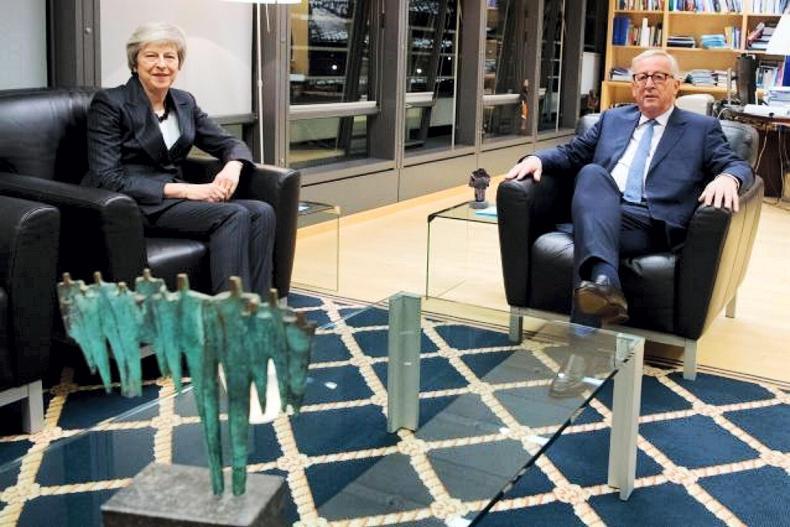


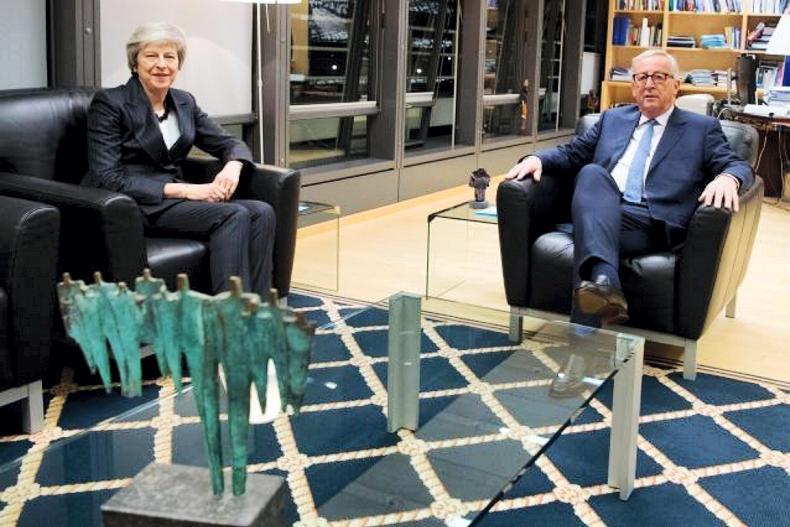
UK prime minister Theresa May came to Brussels this week to put the finishing touches to the agreement that the heads of state will sign off in a special council meeting of the EU on Sunday.
She is scheduled to return on Saturday for further discussions with Commission president Jean Claude Junker, but with the publication on Thursday of a 26-page dossier on a future trading relationship, it is difficult to see what is left to talk about.
EU27 likely to fall into line
While it is possible that there will be a flare-up with Spain over Gibraltar or France over fisheries that could prolong Sunday’s council into a marathon instead of a ceremonial signing occasion, the reality is that the big political debates are going on in London at present.
The PM is under severe pressure from both sides of the referendum debate and in reality there was no compromise deal she could present that would meet the expectations of these irreconcilable positions.
It has taken the UK two years to arrive at a definitive position and no doubt this was very much driven by business in every region of the UK as the departure date of 29 March 2019 comes closer.
Politics versus economics
Having spoken at length with Northern Ireland’s DUP and UUP MEPs this week in Brussels, there is very visible concern on how a future might develop if Northern Ireland was operating under a different customs and regulatory rule book than the rest of the UK.
The political fear is that such a divergence would ultimately, if not immediately threaten the constitutional position of Northern Ireland as part of the United Kingdom.
If we switch from a political to an economic lens, the concern switches to farmers and the agri-food industry south of the border.
If Northern Ireland unionist politicians fear a backstop that applies only to Northern Ireland because of potential constitutional implications, south of the border farmers and the industry have to fear it because of economic implications.
While there is a cross-border trade and an island-of-Ireland economy, the reality is that the main destination for Irish exports is Britain.
A backstop that worked only on the Irish border would be irrelevant for this trade and if the border was in the Irish Sea, exports from the Republic of Ireland would be decimated.
Irish farmers have as much skin in the future trading negotiation preventing the use of an Irish border only backstop as anyone.
Struggle
No matter how well this weekend goes for the UK PM, the reality is that she has an uphill struggle in Westminster. Looking at it logically, she has no chance of getting her deal approved.
However, she has delivered a robust performance over the past 10 days that suggests she will not give up easily.
The overthrow of her Conservative party leadership seems to have fizzled out and when her opponents couldn’t muster 48 signatures out of a potential 315, it suggests that there is a good number of Conservative MPs who see her as the best option available.
The other advantage she has is that the main opposition Labour party seems as divided and uncertain about what shape Brexit should take as the Conservatives do. They have avoided the spotlight because they are in opposition, not Government.
She is also getting some traction from the fact that no matter how loudly her opponents protest, they don’t have an alternative to no deal and there may be acceptance, even if reluctant, that the PM's deal is as good as it gets from a negotiation perspective.
There are very few supporters in Parliament for a no-deal Brexit and no doubt MPs will have heard the screams of industry and farmers across the UK that no deal absolutely isn’t an option.
No election
A further political advantage for Theresa May is that since the fixed Parliament act 2011, loss of a vote on a major issue doesn’t trigger a general election.
It is doubtful if many of the MPs who might oppose her Brexit deal would want this vote as the risk would be Jermy Corbyn as PM and no visible alternative on how to deal with Brexit.
The other option touted as a possible alternative to the deal is having a second referendum or people’s referendum as its advocates call it.
There is no evidence that there are enough members of Parliament who hold this view to make it happen and even if there were, it would be virtually impossible to hold it in the time frame that is available.
Mobilised
The absence of a clear alternative is in many ways the PM’s greatest strength. She has mobilised the business and farming community behind her deal, not because they are enthusiastic but because they are terrified by a no-deal prospect.
The final possible advantage the PM has is that while the opposition to her proposals has been both visible and vocal, it tends to be the same players who are speaking in Parliament or hogging the news bulletins.
That suggests there are many MPs from all parties that are adopting a low-key approach, perhaps listening to the issues being debated rather than offering their view.
They will not be able to delay that beyond the vote.
PM needs all the breaks
From all of this it is possible to visualise a path by which the PM could possibly travel to achieve what looks impossible this weekend – persuade Parliament to approve her proposals.
She needs circumstances to keep falling her way just as the leadership heave seems to have, but if she can do it, that will mean transition and into debate of a future trading relationship.
If we get to that point, farmers on the island of Ireland will be able to relax at least until the end of 2020 and perhaps into 2022 if Michel Barnier’s suggestion is accepted.
That would take us to a British general election and an opportunity for the parties to think afresh. There is no knowing how long a transition might take or what the wider EU view on migration might be by then.
Perhaps after a long negotiation that reaffirms it is not possible to have cake and eat it, the UK might at some point consider re-joining the EU and again shaping the rules that they have had to comply with in the interim?
Irrespective of politics, that is what would serve farmers best economically on the island of Ireland.




SHARING OPTIONS