



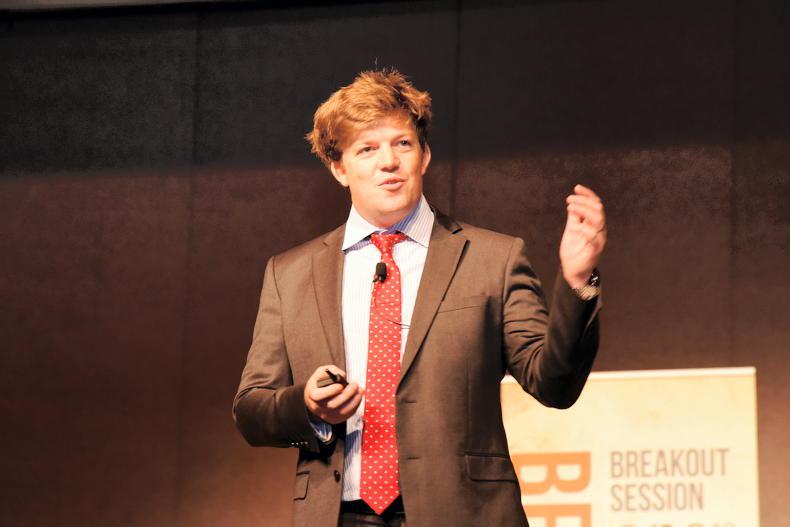
The International Food and Agribusiness Management Association (IFAMA) is a global network that connects business, academic, government, and industry leaders to foster innovation, talent development and sustainable solutions across the global food and agribusiness value chain.
Its annual conference was held at University College Cork (UCC) this month, in tandem with Food and Beverage Finance, an Irish event led by KPMG, Goodbody and AIB. UCC put on a masterclass, proving exactly why this region views itself as a global heavyweight in food systems.
Of course, as a Galway man, it was a little jarring to have to sit through the numerous reminders that Cork is the traditional, undisputed home of Irish dairy. But sitting in those halls, it became clear that Munster is positioning itself for an entirely different title: the epicentre of a new, hybridized frontier where world-class biopharma and advanced dairy nutrition collide.
Look no further than the landscape of Co Cork itself.
The physical proximity of pharmaceutical giants like Eli Lilly to the heartland of Irish dairy co-operatives is no longer just a geographical coincidence; it has the potential of being an important jigsaw piece in the future of nutrition.
At the conference, it was easy to feel that we are moving rapidly toward an era where life sciences and precision manufacturing will heavily inform how we process, value, and functionalise proteins.
Nestlé and others hinted at this changing reality.
This intersection of human biology and food retail was the undercurrent of the most compelling debates at the conference, specifically when looking at the twin forces reshaping consumer demand: the retail impact of GLP-1 weight-loss medications and the deployment of artificial intelligence (AI).
Ireland’s largest retailer Musgrave was present and its CEO spoke about the undercurrent of anxiety regarding GLP-1 drugs with a reported 60 million users in North America already.
Food manufacturers are staring down data showing shifting basket compositions – 12% less food volume – fewer high-calorie, highly processed impulse buys, and a surging demand for lean, nutrient-dense, functional proteins, which means that spending is up.
Retail strategy
The retail strategy to survive this shift relies heavily on data, but during my time on an IFAMA panel, it struck me how starkly divided the global perspective remains on the technology required to harness it. Western discourse leans heavily into a doom-filled view of AI – focusing intensely on risk, displacement, and ethical guardrails. It is a perspective often paralysed by what AI might take away, treating it as an existential threat.
Sharing a more eastern perspective on the panel, I tend to see AI through a much more utilitarian, boots-on-the-ground lens. In rapidly evolving markets, AI isn’t an ideological threat; it is a necessary utility. It is infrastructure deployed to solve immediate, fragmented systemic issues.
When you view AI as a utility, its benefits for agriculture become practical. It is the tool that bridges the data gap between the farm gate, the processor, and the shifting consumer basket. If GLP-1 users are demanding highly specific, verified nutritional profiles, AI is the utility that tracks, optimises, and proves that supply chain resilience in real time.
Ultimately, the produce more versus produce better tension won’t be solved by agriculture acting in isolation. It will be solved by the kind of industry convergence happening right on Cork’s doorstep. The future of food is no longer just about yield per acre.
It is about the intelligence and precision we wrap around the molecule. Cork may have the history, but are also poised to be part of the blueprint for what comes next.




SHARING OPTIONS