



The Irish Farmers Journal estimates total cereal production at 1.99m tonnes for 2026 (see table 3). This is at the average moisture contents reported. This year, crops were harvested at very low moisture contents. When corrected to 20% moisture content this comes to 2.1m tonnes (see table 4). This is below the five-year average figure of 2.16m tonnes and behind the 2025 production figure of 2.23m tonnes.
The figures come from data gathered through a survey of agronomists, the trade and harvest reports from farmers.
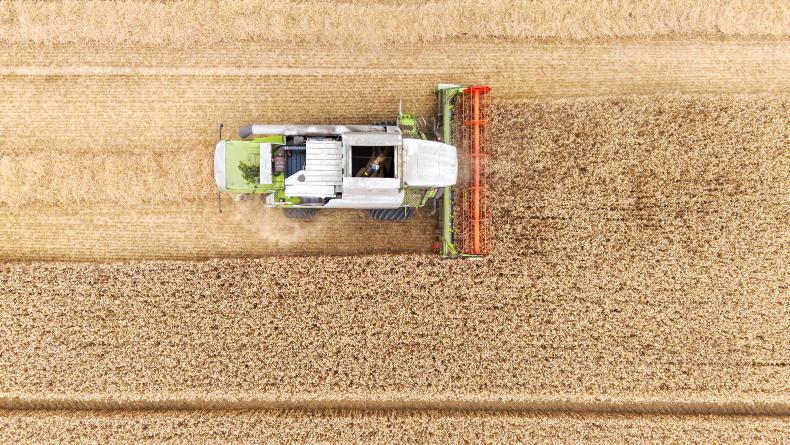
Harvest 2026 is almost wrapped up across the country in one of the earliest finishes to harvest due to the dry and hot summer. Although there are still cereals yet to be cut in some parts and beans as well. However, after the heatwave of July and the dry July and August the harvest was wrapped up on many farms by mid-August, including beans on some farms.
Weather was ideal for harvesting and farmers were happy to be able to go out each day and get their work done. They could plan and some of the work was taken out of straw with the sunny weather. That said crops that looked to have huge potential, lost that potential in the dry weather.
However, there was one clear consequence of the drier weather and that was lower yields. Lower yields were not all down to the drier weather on all crops, but did play a big part. If you take winter barley for example it sat in a wet seedbed for much of the spring time. A mild winter likely resulted in virus. Take winter wheat and it lost green leaf quickly and likely yield as a result.
Winter barley
Winter barley yields ranged from 2.5t/ac to 4.7t/ac in our data (see Table 1).
The higher yields were rare. The average yield was 3.46t/ac and the average moisture content was 14.7%.
Winter barley suffered from some barley yellow dwarf virus (BYDV) and take-all in different fields. While many crops looked promising, some disappointed, but we have to remember back to conditions for winter barley in the spring time. Nitrogen timing made a difference and timings for growth regulator. Crops were stressed for a long time.
Winter wheat
Winter wheat yields ranged from 2.8t/ac to 4.8t/ac. The average yield came in at 3.9t/ac, at a moisture content of 16.6%.
There were plenty of comments on winter wheat. The crops obviously burned in and lost yield due to less green leaf, but BYDV and take-all on second wheats were noted as big issues in some crops.
Winter oats
Winter oats continued their consistent run of form this season as they have in recent years. The average yield reported was about 3.7t/ac, with a range of 3-4.2t/ac at low moisture contents of 16% and below. They were cut immediately after winter barley in many cases and were less impacted by drought when growing .
Spring barley
Spring barley yield ranges reported were from 1.9t/ac to 3.8t/ac. The average spring barley yield was 2.95t/ac and the average moisture content was 14.9%.
Many were surprised with spring barley yields, not that they yielded very well, but that crops did a lot better than expected. Given the short growing season since late April to early/mid-August for many farmers there were poor prospects. Quality was back. Bushels were low and screenings reached over 20% on some farms. Unsurprisingly, the heavier land worked well for spring barley this year and seemed to deliver higher yields, with comments that continuous cereal ground saw poorer spring barley yields.
Spring oats, spring wheat and rye
The areas of spring oats and spring wheat are very low and so the area in each region for agronomists is very low, so some may only have a farm or two to go by for the average. Rye is also a small crop with an estimated 5,400ha planted in 2026.
Spring oats came in at a range of 2.5-3.6t/ac, with an average yield of 3.2t/ac at 16.1% moisture content. Spring wheat yields ranged from 2.75t/ac to 3.75t/ac at an average moisture content reported at 16.4% and an average yield of 3.18t/ac.
Winter rye reports were limited, but the average looks to be around 3.6t/ac at moisture contents of about 18%.
Cereal area down
An important thing to note this year is that the cereal area is down almost 15,000ha from last year. Winter and spring oats area is down by about 10,000ha (see table 2).
Spring barley area is down by over 6,000ha, but winter barley area is up 2,400ha. Winter wheat area is up nearly 5,000ha, while spring wheat area is up 1,000ha.
A higher winter cereal area would normally mean a significant increase in production, but winter barley yields disappointed for many this year, while winter wheat was less than average for many.
The cost of growing winter wheat and the poor yields on many farms this year have become a talking point and no doubt farmers are questioning what crops return most.
Comparison with 2025
In 2025, we carried out our survey mid-harvest. Winter barley and oats had been harvested and the winter wheat harvest was underway. This year, with the early harvest we left our survey until almost all cereal crops were harvested.
In 2025, based on a survey of agronomists we estimated barley, wheat and oats production at 2.252m tonnes. In November, Teagasc estimated 2025 production at 2.23m tonnes.
These figures should help paint a picture for those feeding animals and producing feed. It gives an estimate of the amount of grain in the country and a large amount of this will be available for trading, while some is already purchased by feed mills.
It is disappointing that Irish oats have been in store since harvest 2025, even with a feed deficit on livestock farms.
Participants in the survey were asked if they expected the tillage area to increase, decrease or stay the same in 2026/2027. Half said they expected it to stay the same and half said they expect it to decrease. No one expected it to increase.
If the tillage area continues to decline then the fodder issues will become more of an issue. Bigger thinking is needed from the wider agricultural sector. With high input costs, grain prices not meeting those costs and an expected income of €40,000 on specialist tillage farms this year, the tillage sector needs support or it will decline in area. Feeding Irish grain to livestock could deliver a premium market for meat, milk and cereals.
Thank you to all farmers and agronomists for taking the time to share yield results and help to inform readers on where crop yields and production are at in comparison to other years.



SHARING OPTIONS