



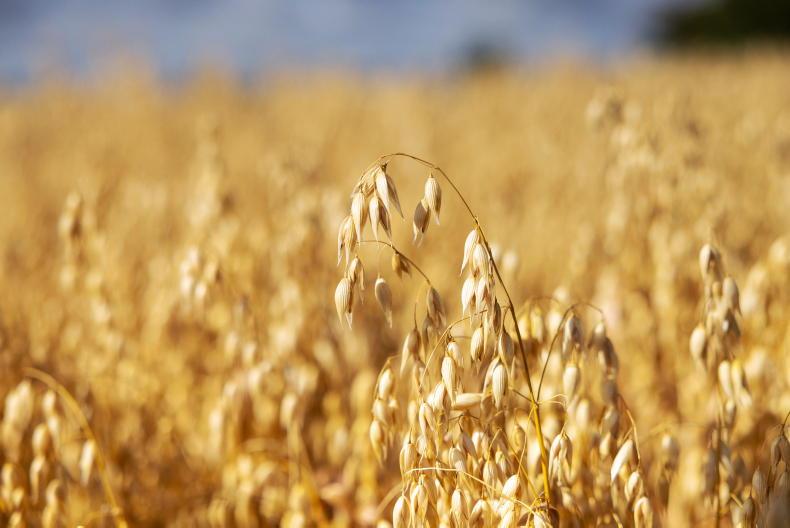
At the Flahavan’s organic oat growers’ conference last week, Teagasc’s organic tillage adviser Martin Bourke outlined some of the cost and return figures for organic spring oats at varying yields.
These figures are displayed in Table 1 and are based on the base price for organic oats paid by Flahavan’s of €415/t.
It is important to note that these figures are based on owned land and do not include other fixed costs such as hedge-cutting, consulting, etc.
The figure is based on the profit from the crop itself and the grain and straw produced.
The figures show that, in all cases, farmers made a profit, although at the lower yields the straw payment played an important role.
For example, at a yield of 2t/ha, the Straw Incorporation Measure (SIM) payment accounted for €250/ha of the €315/ha profit, meaning straw accounted for 80% of the profit per hectare.
However, if you can reach the higher end of the yields at 5t/ha (2t/ac), then straw only contributes to 16% of the profit.
Yields can be hugely variable in all farming systems, but probably more so in organics.
Farmers will know what yields they reach on average on their farm, but it is important for farmers to consider factors that hit their yields.
Conversion
For example, if you are not long out of conversion, your soil indices may still be high enough, but if you don’t do anything to maintain those indices, then yields will fall back.
Those in conversion also need to remember they will take a hit in yields during conversion, but will not receive the organic price premium for their produce.
However, the figures outlined in Table 1 do not include the Organic Farming Scheme payments or the BISS payment or any other schemes apart from the SIM.
Farmers also have the opportunity to take part in ACRES and Farming for Water EIP.
Organic manures
Martin also detailed some trial work on organic manures over a three-year period.
As you would expect, there was a significant yield increase in crops that received organic manures. In the trial, the untreated yield over three years was 3.66t/ha.
Martin said an application of 3,000 gallons per acre of cattle slurry increased yield by 0.55t/ha. He placed the benefit of the cattle slurry at €103/ha and noted it will help to build up K in the soil.
An application of 0.5t/ha of poultry pellets increased yield by 0.59t/ha. He said this places the payback on the pellets at about breakeven at a cost of €210/t for pellets.



SHARING OPTIONS