It hasn’t got any easier. Having run out of grass silage, we’ve temporarily solved the problem by zero-grazing a few of the heavy paddocks left over from last autumn. I mentioned a few weeks ago that we were having difficulty grazing them out properly and I was interested to see one of the BETTER farms in last week’s Irish Farmers Journal refer to the same problem.
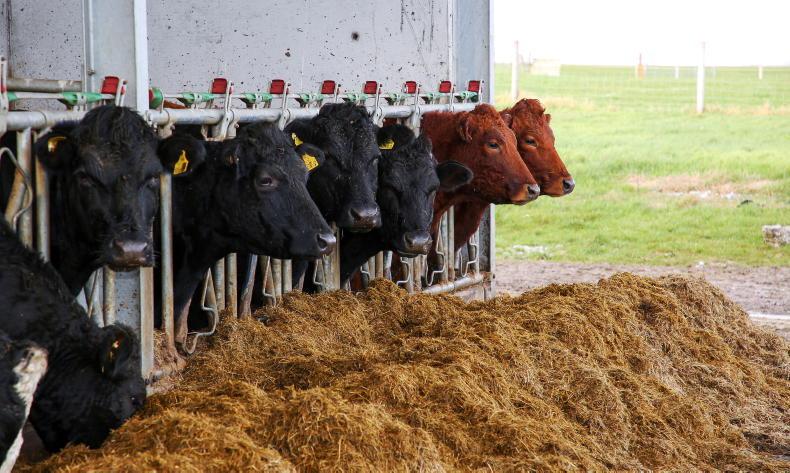
What we have found for some reason is that trying to graze them out fully makes a mess of the paddock and the ground when compared with the freshly grown grass which is consumed much more easily and with much less poaching and ground damage. So what we have tried is to zero-graze and bring in round bales of grass, chop it in the feeder and add in about 2kg of maize silage per head. This mixture seems to give a more palatable feed, the intakes have improved and there is very little damage being done to the ground which, considering the weather we have had, is surprisingly firm.
This arrangement will last a few days and we will then have to reassess as we wait to decide if the cattle can stay out morning and night. Some areas that have not got any slurry, on less than perfectly drained ground, have the beginnings of a dull brown colour from low night-time temperatures and water-logging and will not be fit for grazing for a while.
ADVERTISEMENT
Our local factory is giving a report on the liver and lung conditions of each animal slaughtered. At this time of the year, coming to the end of the cattle, not only are carcase weights dropping off – in other words, we have a poor weight for age performance – but also we are getting the first reports of liver damage. Most of the liver damage is coming in cattle that have been bought as weanlings in the spring because we didn’t have enough room in the sheds in the autumn before last. I’m beginning to wonder if the fluke control regime in weanlings being sold after Christmas is inadequate and long-lasting damage is being done.
Meanwhile, I am buying nitrogen on a hand-to-mouth basis as the price continues to decline.
Register for free to read this story and our free stories.
This content is available to digital subscribers and loyalty code users only. Sign in to your account, use the code or subscribe to get unlimited access.
The reader loyalty code gives you full access to the site from when you enter it until the following Wednesday at 9pm. Find your unique code on the back page of Irish Country Living every week.
CODE ACCEPTED
You have full access to the site until next Wednesday at 9pm.
CODE NOT VALID
Please try again or contact support.
It hasn’t got any easier. Having run out of grass silage, we’ve temporarily solved the problem by zero-grazing a few of the heavy paddocks left over from last autumn. I mentioned a few weeks ago that we were having difficulty grazing them out properly and I was interested to see one of the BETTER farms in last week’s Irish Farmers Journal refer to the same problem.
What we have found for some reason is that trying to graze them out fully makes a mess of the paddock and the ground when compared with the freshly grown grass which is consumed much more easily and with much less poaching and ground damage. So what we have tried is to zero-graze and bring in round bales of grass, chop it in the feeder and add in about 2kg of maize silage per head. This mixture seems to give a more palatable feed, the intakes have improved and there is very little damage being done to the ground which, considering the weather we have had, is surprisingly firm.
This arrangement will last a few days and we will then have to reassess as we wait to decide if the cattle can stay out morning and night. Some areas that have not got any slurry, on less than perfectly drained ground, have the beginnings of a dull brown colour from low night-time temperatures and water-logging and will not be fit for grazing for a while.
Our local factory is giving a report on the liver and lung conditions of each animal slaughtered. At this time of the year, coming to the end of the cattle, not only are carcase weights dropping off – in other words, we have a poor weight for age performance – but also we are getting the first reports of liver damage. Most of the liver damage is coming in cattle that have been bought as weanlings in the spring because we didn’t have enough room in the sheds in the autumn before last. I’m beginning to wonder if the fluke control regime in weanlings being sold after Christmas is inadequate and long-lasting damage is being done.
Meanwhile, I am buying nitrogen on a hand-to-mouth basis as the price continues to decline.
If you would like to speak to a member of our team, please call us on 01-4199525.
Link sent to your email address
We have sent an email to your address. Please click on the link in this email to reset your password. If you can't find it in your inbox, please check your spam folder. If you can't find the email, please call us on 01-4199525.
ENTER YOUR LOYALTY CODE:
The reader loyalty code gives you full access to the site from when you enter it until the following Wednesday at 9pm. Find your unique code on the back page of Irish Country Living every week.










SHARING OPTIONS