


The last week has seen farmers faced with a range of weather conditions from torrential rain and heavy flooding to harsh winds with severe wind chill and heavy snowfalls in the North of the country.
Grass growth has gone into reverse in many areas and with the weather forecast showing no signs of reprieve, many farmers are now facing, or already experiencing, serious fodder problems.
Weighing up your options
The first step you can take is to firstly weigh up the options available to you. Below are a number of alternatives that can be considered to overcome immediate difficulties.
1. Spread nitrogen at 30 to 35 units per acre on all grassland.
2. Prepare to graze as much silage ground as necessary.
3. Set up temporary grazing systems, including water supply, to maximise grass utilisation.
4. Avoid turn out to bare pastures or very light covers; allow some accumulation of grass before grazing, “It takes grass to grow grass”.
5. Where some, but not enough grass is available, it is more sensible to have some animal groups at grass and some on winter feed, rather than have all animal groups at grass with supplementary feed. This will only increase field damage and delay grass regrowth.
6. Buy in appropriate feed to bridge the gap to grass.
7. Cattle near finish could be fed high concentrate diets and marketed as soon as possible.
Buying feed
Feed can be bought as roughage or concentrate. Roughage is variable in quality, costly and laboursome to transport. Hay or good straw are preferable to silage from this point of view, having more dry matter for a given load volume.
The preferred option in most cases is to buy concentrate feed to supplement scarce fodder until grass is available.
The principles are straightforward:
1. Cattle need a minimum amount of roughage to ensure healthy rumen function. The lowest level of roughage required is for ad-lib meal diets. Outside of this, animals will ideally be offered in the region of 50% of their nutritional requirement in the form of roughage.
2. High performance is not a requirement, maintenance plus minimal growth (0.2 to 0.4 kg/day) is the objective for yearlings/stores.
3. Maintenance of milk production without excessive weight loss is the target for suckler cows
4. Because we do not have high performance targets, some cheaper feeds can have a role in this emergency-feeding situation.
How much to feed?
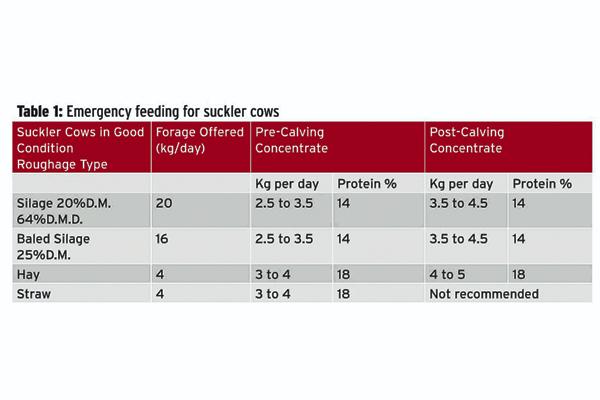
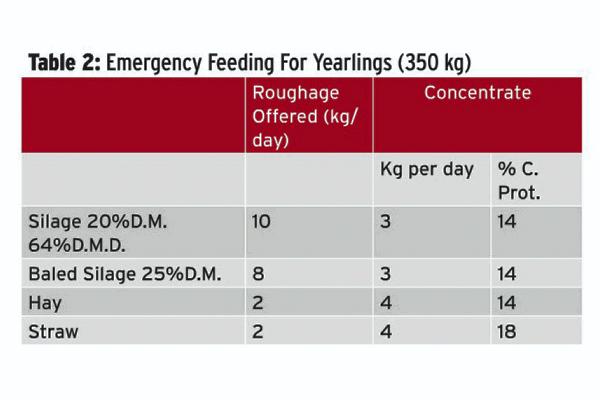
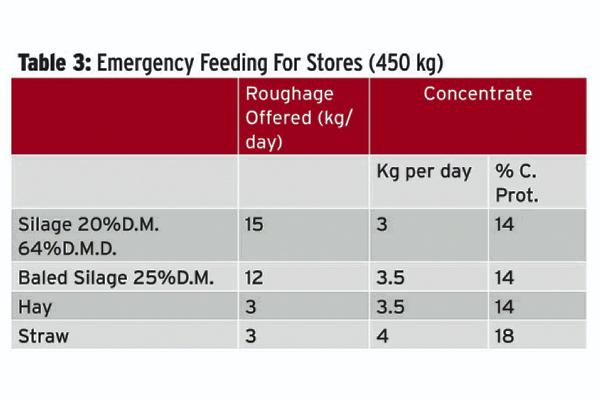
Table 1, 2 and 3 outlines the feed requirements of various classes of stock. The feed levels in the table are appropriate for animals in good condition; add 1 kg to the concentrate allowance where cattle are thin.
The assumption is that the feeding period will not be longer than 4 weeks. Longer periods could lead to stunting of growing animals or rebreeeding problems in suckler cows.
It will be necessary to watch carefully the condition of cows, in particular, severe weight loss should not be allowed to happen.
Ration formulation
Rations for cows suckling calves on hay or straw based diets and for all animals fed on straw as the roughage source should contain 18-20% crude protein as fed.
All other situations are satisfactorily catered for at about 14-16%. Cow rations should be fortified with pre- or post-calving minerals as appropriate, and these must never be confused (post calving fed pre calving and vice versa) or omitted.
Most feed compounders have a range of rations available for cattle, and in general the cheaper, lower specification compounds will suffice for this purpose where the low level of protein is required (14%). Looking for very specific individual formulations adds unnecessary cost for the compounder, which will be passed on to the feeder.
*Siobhan Kavanagh is a Nutrition Specialist with Teagasc
Key points
1. Get fertilizer out as the weather permits
2. If you are completely out of forage, you will have to feed some forage, animals won’t survive on concentrates alone
3. Pay no more than €25-30 for baled silage. Pit silage, of the same quality, is only worth 10% more.
4. If cashflow is a problem, talk to the bank or consider selling some surplus stock
5. If you have animals for finishing, reduce the demand for fodder by feeding ad lib meals and minimum roughage. Remember to build up meals gradually.
6. There is help available to deal with the current fodder situation, talk to the local Teagasc adviser – whether you are a client or not.




SHARING OPTIONS