New genomic techniques have the potential to change the world of crop-growing. So, what are they? Why has European regulation delayed their use and how can they help tillage farmers here in Ireland? In this article, Ewen Mullins, head of crop science at Teagasc, answers some of these questions.
What are NGTs?
NGT (new genomic techniques) is a term used to cover a range of new crop breeding approaches that can deliver varieties with enhanced performance and/or quality traits in a faster and more precise manner.
Can NGTs deliver for farmers?
Yes. Outside of Europe, NGT breeding is already delivering. For example, NGT breeding has been used to generate novel rice varieties for the Indian market with improved drought and salt tolerance.
In Chile, a wheat variety with up to 10 times higher dietary fibre has been approved for cultivation, while Japan has market-authorized a novel potato with higher tuber set, made possible via precision NGT breeding.
Other studies have demonstrated how NGTs can mitigate the impact of inclement weather through a growing season – whether it is heat, drought or waterlogging – as well enhancing nutrient use efficiency to support reduced fertiliser use
Of direct relevance to Irish farmers, published research shows how NGTs can deliver prototype varieties with enhanced disease resistance, such as blight in potato, mildew in wheat, clubroot in oilseed rape plus PVY in potato.
Other studies have demonstrated how NGTs can mitigate the impact of inclement weather through a growing season – whether it is heat, drought or waterlogging – as well enhancing nutrient use efficiency to support reduced fertiliser use.
Are there different types of NGTs?
There are two NGT approaches that can be used separately or together to generate an enhanced variety. One is the ‘cisgenic’ approach, which includes the introduction of genetic material from a crossable species only.
This means the delivery of genetic material from a wild species into a related commercial variety (eg wild potato to conventional potato, wild barley to commercial barley varieties). For this, breeders will only exploit material that is already available to them within their breeding collection or ‘gene pool’.
This is the total genetic information that is already available for current, conventional breeding practices.

Gene editing involves slight rearrangement of a cell's own DNA to alter the traits it exhibits without altering the make-up of its genetic code.
The other NGT approach is ‘editing’, which is a targeted approach where it is possible to change or edit the DNA sequence that is already in a variety without introducing any new genetic material. The approach is often called CRISPR ‘editing’ and is about targeting specific DNA sequences that already exist within a plant that control a trait of interest.
With editing it is possible to modulate a variety’s trait of interest in a very precise manner.
How long does it take to develop a new variety using NGTs?
NGT approaches have the capacity to accelerate the breeding process significantly. Dependent on the crop, NGT approaches can reduce the breeding time by more than 30%.
This means generating a new variety of potato in six to seven years, a new barley/wheat variety in about seven years versus standard breeding approaches which take ~12 and ~10 years respectively.
Can NGTs do anything else?
Yes. NGTs allow breeders to complement existing varieties that already meet market specifications but maybe are deficient in a trait important for field performance, or indeed vice versa.
Like an updated smartphone, this will result in an updated variety: a version 2.0 that has all the original characteristics demanded by processors in the market but now meets a farmer’s need to say reduce inputs.
Has this been achieved for an Irish crop?
From 2013-2015, Teagasc evaluated an NGT-derived potato in Oak Park. It was a cisgenic-bred potato variety with enhanced blight resistance due to the transfer of a wild potato gene into the commercial variety (Desirée) that is popular in continental markets.
The NGT-derived potato enabled a 75% reduction in fungicide usage compared to conventional Desirée when combined with a tailored IPM regime.
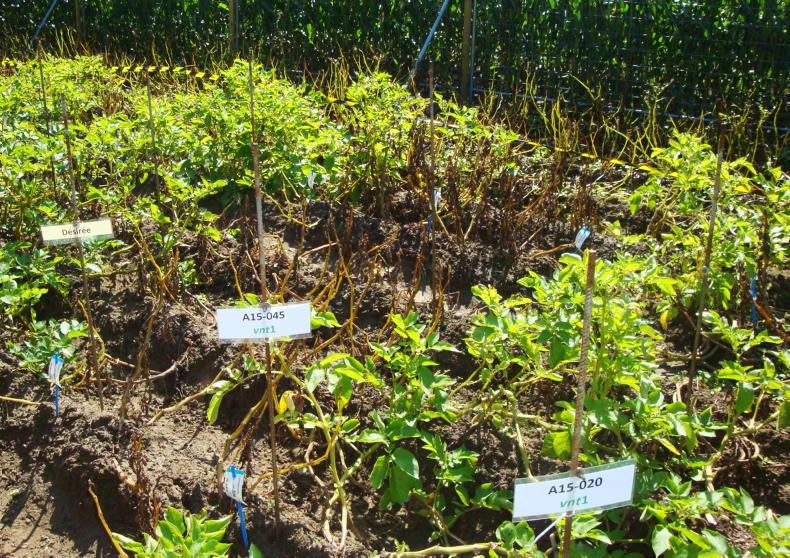
Desiree potatoes showing resistance to blight.
Of significance, environmental monitoring, that focused on sensitive soil microbes, including bacteria, fungi and nematodes, showed no adverse effects on soil biodiversity compared to controls, even under IPM conditions.
Why are NGTs back in the news now?
At the end of 2025, an agreement was reached between the European Commission, Council and Parliament on a new regulation to support the generation of plant varieties using NGT approaches.
The regulation separates NGT derived plant varieties into two Categories (I and II), based on the number of changes made to generate the new variety.
Category II varieties will require more regulatory evaluation because the plants will have undergone more extensive changes to the genome. It is therefore anticipated that breeders will focus on Category I, which provides ample scope to achieve novel varieties with improved performance and/or quality.
What does the new EU regulation mean?
The regulation states that NGT (Category I) derived plant varieties should be treated in the same way as varieties produced by conventional breeding techniques, given that they are equivalent and their risks are comparable.
To support this, the regulation describes certain technical criteria that NGT varieties must comply with to ensure equivalence is achieved.
Why is the agreement significant?
The new regulation will, for the first time, permit the use of NGT techniques in crop breeding without having to assess the novel crop variety through a lengthy regulatory process.
Why has Europe gone down this avenue?
Europe is actually behind other jurisdictions when it comes to adopting these approaches. The UK completed their Precision Breeding act in early 2025, Canada in 2024 and Australia in 2019, with many others having already streamlined regulations to support use.
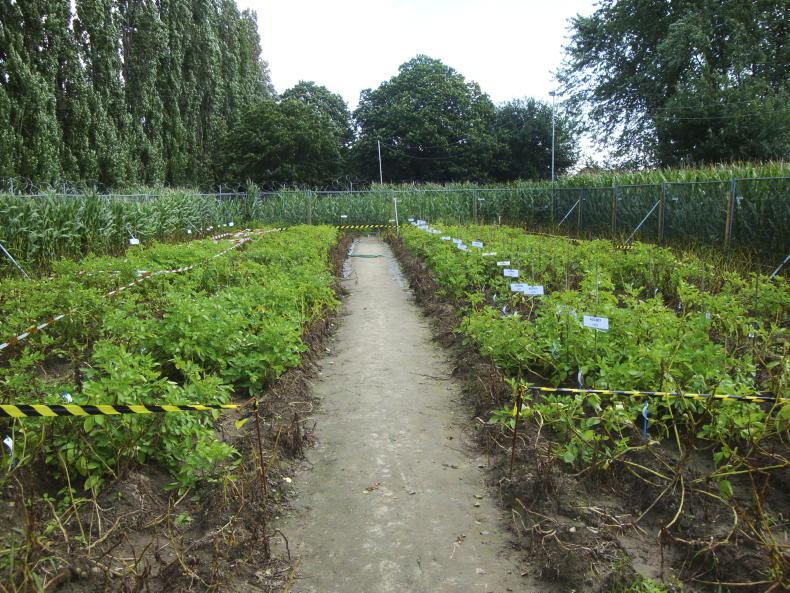
A GM blight trial in Europe showing varietal resistance. The new rules will not allow GM crops to be grown in Europe. The new regulation will allow for crops developed through NGT approaches.
What happens if an NGT-derived variety is crossed with a conventionally bred variety?
As both an NGT derived variety and a conventionally bred variety are now considered equivalent in the EU, the resulting progeny will therefore be considered the same and will not be required to go through any additional evaluation process.
Can NGT-derived plant varieties be used in organic production?
No. Although NGT material is now considered equivalent to conventionally bred material and indeed NGT material could have valuable traits relevant to organic systems, the new regulation is clear that NGT plants are prohibited from organic production.
All plants that are generated using NGT breeding will be included in a publicly available database. Also, the seed (or any other reproductive material) on the market that is NGT derived should also be labelled to state this.
What does it mean for the farmer?
Ultimately, it means that new varieties will come to market with important traits to support both the environmental and economic sustainability of farming systems.
A key advantage NGTs will bring to breeding is the ability for breeders to stack multiple genes for resistance into the one variety.
This will allow varieties to stay one step ahead of our important crop diseases, which have a significant ability to adapt. With durable disease resistance in varieties via NGT breeding, it will finally be possible to consider realistic pesticide reduction targets.
Looking to research on a global scale, substantial work is also underway to dramatically increase crop yield potential using NGT approaches. While the tillage sector’s grain is already recognised as having a low carbon footprint, increasing the yield potential of a crop from the same land used, would further decrease the carbon footprint, adding more to the unique selling point of Irish grains.
It is also important to point out that NGTs are not isolated to tillage crops, they can also apply to horticultural crops and certain forestry species.
Is it possible to tell the difference between a variety developed through an NGT approach and a traditional, longer conventional breeding approach?
No. While diagnostic tests will be able to identify the genetic change, the method of doing it and the outcome could be equally achieved through NGTs or by a conventional approach.
So, while both systems will get you to the end point of developing that new variety, the conventional approaches will take an inordinate amount of time and can lead to some negative trade-offs that you don’t want in the developed variety.
When will new varieties come to market?
It is anticipated that the first generation of varieties could start to appear in national evaluation trials by 2029 but this is dependent on how quickly breeding companies (large and small) as well as research institutions ramp up their production systems, now that the regulatory landscape has finally been clarified with this new EU regulation.
Will NGTs add costs to seed for farmers?
It is too early to say if there would be an added cost on NGT-derived seed. On one hand, as NGT varieties can be developed in a shorter time, development costs would be reduced significantly.
Yet breeders may have to incur additional costs on the licensing of the NGT technology from developers.
The other complicating factor to consider is that costs will likely differ relative to the complexity of the trait(s) introduced and the crop enhanced.
New genomic techniques have the potential to change the world of crop-growing. So, what are they? Why has European regulation delayed their use and how can they help tillage farmers here in Ireland? In this article, Ewen Mullins, head of crop science at Teagasc, answers some of these questions.
What are NGTs?
NGT (new genomic techniques) is a term used to cover a range of new crop breeding approaches that can deliver varieties with enhanced performance and/or quality traits in a faster and more precise manner.
Can NGTs deliver for farmers?
Yes. Outside of Europe, NGT breeding is already delivering. For example, NGT breeding has been used to generate novel rice varieties for the Indian market with improved drought and salt tolerance.
In Chile, a wheat variety with up to 10 times higher dietary fibre has been approved for cultivation, while Japan has market-authorized a novel potato with higher tuber set, made possible via precision NGT breeding.
Other studies have demonstrated how NGTs can mitigate the impact of inclement weather through a growing season – whether it is heat, drought or waterlogging – as well enhancing nutrient use efficiency to support reduced fertiliser use
Of direct relevance to Irish farmers, published research shows how NGTs can deliver prototype varieties with enhanced disease resistance, such as blight in potato, mildew in wheat, clubroot in oilseed rape plus PVY in potato.
Other studies have demonstrated how NGTs can mitigate the impact of inclement weather through a growing season – whether it is heat, drought or waterlogging – as well enhancing nutrient use efficiency to support reduced fertiliser use.
Are there different types of NGTs?
There are two NGT approaches that can be used separately or together to generate an enhanced variety. One is the ‘cisgenic’ approach, which includes the introduction of genetic material from a crossable species only.
This means the delivery of genetic material from a wild species into a related commercial variety (eg wild potato to conventional potato, wild barley to commercial barley varieties). For this, breeders will only exploit material that is already available to them within their breeding collection or ‘gene pool’.
This is the total genetic information that is already available for current, conventional breeding practices.
Gene editing involves slight rearrangement of a cell's own DNA to alter the traits it exhibits without altering the make-up of its genetic code.
The other NGT approach is ‘editing’, which is a targeted approach where it is possible to change or edit the DNA sequence that is already in a variety without introducing any new genetic material. The approach is often called CRISPR ‘editing’ and is about targeting specific DNA sequences that already exist within a plant that control a trait of interest.
With editing it is possible to modulate a variety’s trait of interest in a very precise manner.
How long does it take to develop a new variety using NGTs?
NGT approaches have the capacity to accelerate the breeding process significantly. Dependent on the crop, NGT approaches can reduce the breeding time by more than 30%.
This means generating a new variety of potato in six to seven years, a new barley/wheat variety in about seven years versus standard breeding approaches which take ~12 and ~10 years respectively.
Can NGTs do anything else?
Yes. NGTs allow breeders to complement existing varieties that already meet market specifications but maybe are deficient in a trait important for field performance, or indeed vice versa.
Like an updated smartphone, this will result in an updated variety: a version 2.0 that has all the original characteristics demanded by processors in the market but now meets a farmer’s need to say reduce inputs.
Has this been achieved for an Irish crop?
From 2013-2015, Teagasc evaluated an NGT-derived potato in Oak Park. It was a cisgenic-bred potato variety with enhanced blight resistance due to the transfer of a wild potato gene into the commercial variety (Desirée) that is popular in continental markets.
The NGT-derived potato enabled a 75% reduction in fungicide usage compared to conventional Desirée when combined with a tailored IPM regime.
Desiree potatoes showing resistance to blight.
Of significance, environmental monitoring, that focused on sensitive soil microbes, including bacteria, fungi and nematodes, showed no adverse effects on soil biodiversity compared to controls, even under IPM conditions.
Why are NGTs back in the news now?
At the end of 2025, an agreement was reached between the European Commission, Council and Parliament on a new regulation to support the generation of plant varieties using NGT approaches.
The regulation separates NGT derived plant varieties into two Categories (I and II), based on the number of changes made to generate the new variety.
Category II varieties will require more regulatory evaluation because the plants will have undergone more extensive changes to the genome. It is therefore anticipated that breeders will focus on Category I, which provides ample scope to achieve novel varieties with improved performance and/or quality.
What does the new EU regulation mean?
The regulation states that NGT (Category I) derived plant varieties should be treated in the same way as varieties produced by conventional breeding techniques, given that they are equivalent and their risks are comparable.
To support this, the regulation describes certain technical criteria that NGT varieties must comply with to ensure equivalence is achieved.
Why is the agreement significant?
The new regulation will, for the first time, permit the use of NGT techniques in crop breeding without having to assess the novel crop variety through a lengthy regulatory process.
Why has Europe gone down this avenue?
Europe is actually behind other jurisdictions when it comes to adopting these approaches. The UK completed their Precision Breeding act in early 2025, Canada in 2024 and Australia in 2019, with many others having already streamlined regulations to support use.
A GM blight trial in Europe showing varietal resistance. The new rules will not allow GM crops to be grown in Europe. The new regulation will allow for crops developed through NGT approaches.
What happens if an NGT-derived variety is crossed with a conventionally bred variety?
As both an NGT derived variety and a conventionally bred variety are now considered equivalent in the EU, the resulting progeny will therefore be considered the same and will not be required to go through any additional evaluation process.
Can NGT-derived plant varieties be used in organic production?
No. Although NGT material is now considered equivalent to conventionally bred material and indeed NGT material could have valuable traits relevant to organic systems, the new regulation is clear that NGT plants are prohibited from organic production.
All plants that are generated using NGT breeding will be included in a publicly available database. Also, the seed (or any other reproductive material) on the market that is NGT derived should also be labelled to state this.
What does it mean for the farmer?
Ultimately, it means that new varieties will come to market with important traits to support both the environmental and economic sustainability of farming systems.
A key advantage NGTs will bring to breeding is the ability for breeders to stack multiple genes for resistance into the one variety.
This will allow varieties to stay one step ahead of our important crop diseases, which have a significant ability to adapt. With durable disease resistance in varieties via NGT breeding, it will finally be possible to consider realistic pesticide reduction targets.
Looking to research on a global scale, substantial work is also underway to dramatically increase crop yield potential using NGT approaches. While the tillage sector’s grain is already recognised as having a low carbon footprint, increasing the yield potential of a crop from the same land used, would further decrease the carbon footprint, adding more to the unique selling point of Irish grains.
It is also important to point out that NGTs are not isolated to tillage crops, they can also apply to horticultural crops and certain forestry species.
Is it possible to tell the difference between a variety developed through an NGT approach and a traditional, longer conventional breeding approach?
No. While diagnostic tests will be able to identify the genetic change, the method of doing it and the outcome could be equally achieved through NGTs or by a conventional approach.
So, while both systems will get you to the end point of developing that new variety, the conventional approaches will take an inordinate amount of time and can lead to some negative trade-offs that you don’t want in the developed variety.
When will new varieties come to market?
It is anticipated that the first generation of varieties could start to appear in national evaluation trials by 2029 but this is dependent on how quickly breeding companies (large and small) as well as research institutions ramp up their production systems, now that the regulatory landscape has finally been clarified with this new EU regulation.
Will NGTs add costs to seed for farmers?
It is too early to say if there would be an added cost on NGT-derived seed. On one hand, as NGT varieties can be developed in a shorter time, development costs would be reduced significantly.
Yet breeders may have to incur additional costs on the licensing of the NGT technology from developers.
The other complicating factor to consider is that costs will likely differ relative to the complexity of the trait(s) introduced and the crop enhanced.






SHARING OPTIONS