


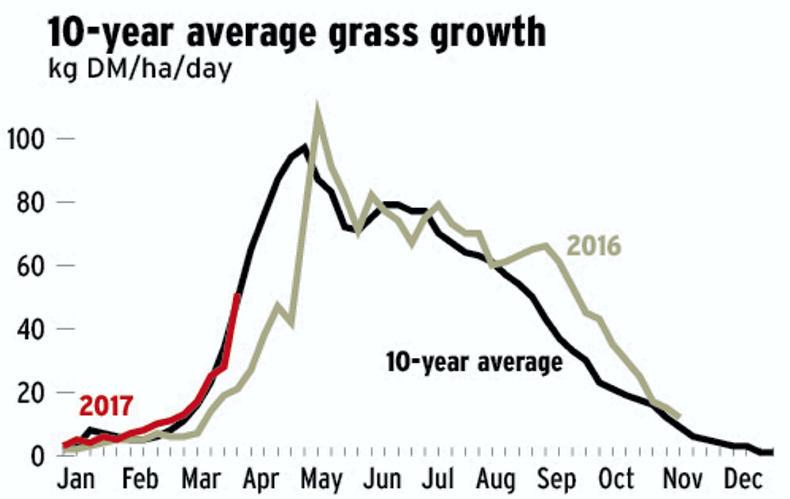
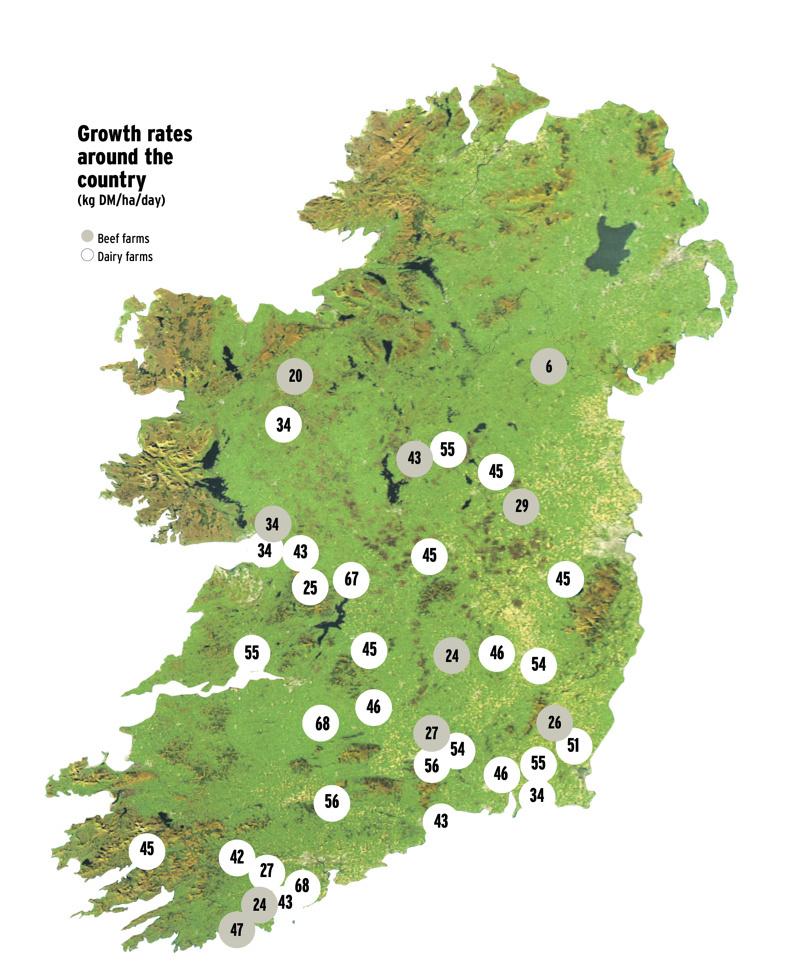




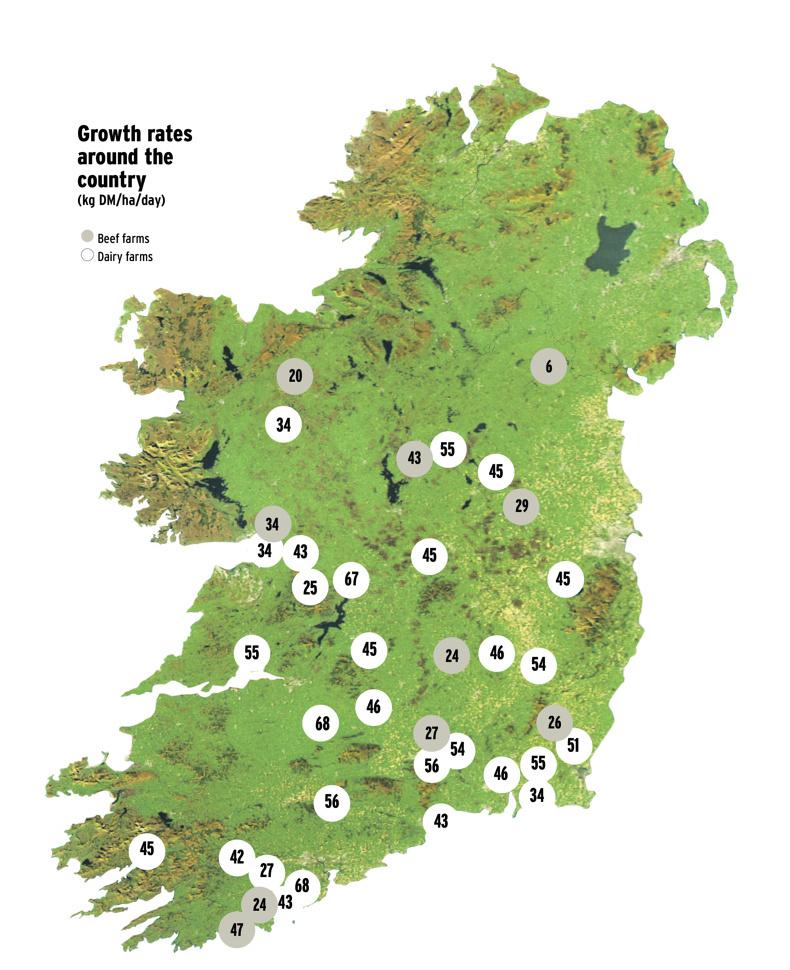
Grass growth on our measuring beef and sheep farms remains unchanged from last week, at 28kg DM/ha/day. However, this is still around 40% ahead of the 10-year average figure for this time of the year.
It is showing – farms that got little or no early fertiliser out are reporting big farm covers as stock turn out to grass. For many, mowers will be out in April, as the battle against stem begins.
With luck, ground conditions will improve to allow stronger grass areas be taken for bales in advance of any main silage cuts.
The best grass managers will tell you that getting on top of grass in the coming weeks is the secret to a good grazing year.
Traditionally the focus was on May, but with this year and last year’s early growth pattern, keeping a lid on things in April is becoming just as important.
Things should be tightening now as silage ground is closed up.
The target from now is to have 12 to 14 days of grazing on the farm – daily grazing demand being stocking rate in LU/ha x 18kg DM. So, a farm stocked at 1.9LU/ha will have a daily grass demand of 34kg DM/ha. Indeed, a farm stocked at 1.9LU/ha should be hitting its “magic day” any time now – that is, the point at which it is growing more grass than it utilises in a day.
A farm’s magic day is obviously stocking rate dependent, but most should be seeing theirs very soon, particularly given the dry, warm weekend in store.
Many around the country will be praying that the forecasters got this one right. Though growth has been good recently, ground conditions for many have not. There are plenty of stock around the country still indoors, even on good ground.
A lot of farmers had planned to go out last weekend, but the unsettled weather on Saturday put paid to these intentions. Big silage stocks from 2016 mean that many are happy to delay turnout for another couple of days.
What’s strange for such a small island is that there are some farmers hitting their magic day at the moment and on track to begin their second rotation of the farm soon, albeit a few days behind; while others have yet to get stock out to grass. Is it really all down to land type?
Co Cork
System: suckler to weanling
Soil: heavy
Avg farm cover: 861kg DM/ha
Grass growth: n/a
I have decided to close up ground for silage. Some of the ground wasn’t grazed in the spring, as weather was too wet to travel and now covers have gotten out of hand. I intend to cut silage any time from mid-May onwards. Quality is my No 1 target this year, given I am autumn calving and wish to reduce my meal intake to the minimum.
Land that received 2,500 to 3,000 gallons of slurry in spring will get two bags of urea per acre now, as I have enough P & K applied for a silage cut. In all, 3,000 gallons of cattle slurry is worth around 20 units of N, 18 units of P and 90 units of K. Any land that got little or no slurry will be balanced with 0-7-30 or 18-6-12, depending on requirements.
Once my nutrient management plan is complete I will begin to work on improving my soil fertility. As I have some peat land I might not have large lime requirements.
I intend to turn out stock again towards the weekend.
Co Monaghan
System: suckler to bull beef
Soil: heavy drumlin
Avg farm cover: 719kg DM/ha
Grass growth: 39kg DM/ha/day
Ground conditions still remain difficult for grazing. To date the only stock out on farm are yearling heifers, which were turned out on 13 March, and spring-calving cows are been turned out in groups as they calve.
Zero grazing has been ongoing since 14 March. Currently, 14 bulls, 20 yearling heifers and 15 autumn calving cows are being fed zero-grazed grass. The silage ground that is being grazed off will be closed next week and given 2,000 gallons of slurry, two-plus bags of CAN and a half bag of 10-10-20. Soil pH is an issue on the farm and will be addressed in the coming year with a proportion of the farm earmarked for at least 2t/acre of lime this year.
Calving is going well so far. All calves have come healthy and with good vigour. However, one worry is that calving is running around a month later than last year, possibly due to issues with one of my bulls, so this will have to be closely monitored during the coming season.
Co Sligo
System: suckler to weanling
Soil: free draining loam with peat
Avg farm cover: 723kg DM/ha
Grass growth: 20kg DM/ha/day
Thankfully, ground conditions are beginning to improve here, and with the increasingly settled weather this week I hope to get more cows out to grass. I spread 23 units of nitrogen in early-March, and paddocks have greened up but are still slow to bulk up.
Soil fertility is something I’m really going to work hard at, and lime is an issue here. Two tonnes of lime was spread on the barer grazing ground last week, and I’ll continue to work on soil pH throughout the year.
I turned out 11 cows that were in poorer condition last weekend and freshly calved cows will go out this week. All of my calves have been out grazing all winter. Locking the calves out by day has not only contributed to the good conception rate but the calves are beginning to kick on at grass now – and you’d be surprised how much grass they would actually get through. Normally, I sell weanlings in the autumn, but this year I hope to hold on to some for finishing.
Newford Herd, Co Galway
System: suckler to steer beef
Soil: dry to heavy
Avg farm cover: 1,073kg DM/ha
Growth: 48kg DM/ha/day
There have been 89 yearlings grazing silage ground since 14 March and this will be closed in the coming days. In terms of our spring rotation planner, 93% of the home farm has been grazed off (24.98 ha) and 27% has been grazed on the three outfarms. In total, 53% of the farm has been grazed.
Ground condition improved last week and 14ha of grazing ground on the home farm got 23 units/acre of N (urea), and 2,000 gallons/acre of cattle slurry was spread on the rest.
From 98 cows we have 101 calves, with four sets of twins and one loss.
In all, 92% as now calved in just over eight weeks with no major problems. The average calf birth weight is 43kg and the average calving score is 1.49. In terms of ease, 91% have a calving score between one (no assistance) and two (some assistance). Frustratingly, we had a cow lost just after she was let off the trailer to grass, which the vet put down to a heart attack.


SHARING OPTIONS