



Space requirement
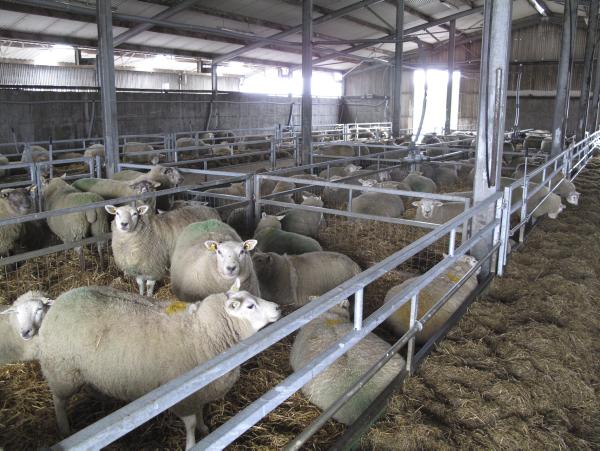
The recommended floor space for housed in-lamb ewes (unshorn) is detailed in Table 1. Where sheep are shorn, the recommended floor space reduces by 20%. Where ewes are housed with lambs, a ewe with a single lamb requires 30% more floor space while a ewe with twins requires 60% extra floor space.
On many farms, sheep are housed in converted sheds or housing that was not designed solely with housing sheep in mind. In a lot of cases there is more than adequate pen floor space available, but there is not enough feeding space available to let all ewes eat together.
Recommended feeding space for different sized ewes is detailed in Table 2. Be careful to make allowances in late pregnancy so that all ewes can easily eat without undue competition at the feeding face.
The feeding space requirement can be altered by introducing meal troughs into pens when supplementing meals or by installing walk through feed troughs as pen dividers or feeding racks.
Lambs weighing up to 45kg and fed ad-lib concentrates require about 100mm feed space while lambs fed a restricted diet require about 300mm feeding space.
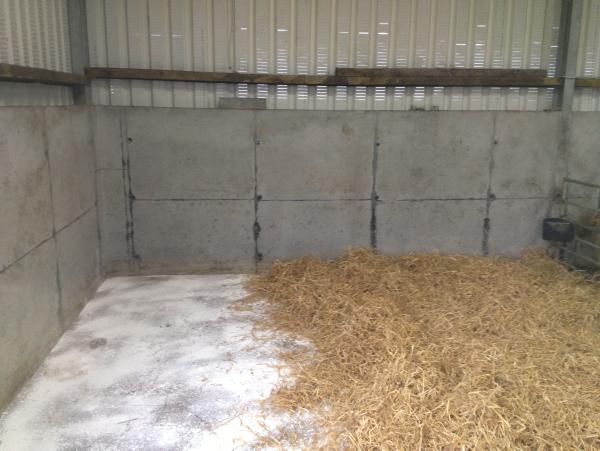
Straw bedding
On average, lowland ewes require about 7kg straw bedding per week while hill ewes require 4kg to 5kg per week. As a general guide, a 4x4 round bale of straw weighing 140kg will be sufficient to bed about 18 to 20 lowland ewes or 30 to 35 hill ewes for a week (silage diet).
Over a 100-day winter this equates to about 70 4x4 round bales for 100 lowland ewes and 50 bales for 100 hill ewes.
The straw requirement will be influenced by diet with ewes fed hay or high concentrate diets having a lower bedding requirement than ewes fed silage. For example, over a 100-day housing period, an average sized ewe on a silage diet will require 72kg straw bedding to absorb all urine.
||PIC2||
This will reduce to 45kg to 55kg for ewes fed hay or haylage, respectively. Store lambs housed on straw bedding for intensive finishing on concentrates will require approximately 20kg to 25kg straw bedding over a 60 to 70-day finishing period.
When calculating, if you have enough straw, take note that the weight of bales can vary significantly. Standard 4x4 round bales of straw weigh, on average, 150kg to 160kg but can vary in weight from 130kg in poorly packed bales to 180kg in solidly packed bales. Large square 8x4x4 bales weigh about 540kg to 580kg and again this can vary from 480kg to 600kg. Medium square 8x4x3 bales weigh about 350kg to 380kg. When using weight as a guide, assess bales on how tightly they are packed so that a high moisture content is not responsible for heavier weight.
Water requirement
The water intake of animals will obviously be influenced most by their diet. It is critical that ewes have free access to clean water at all times. As a general guide, Teagasc recommends that ewes in mid-pregnancy require 3.2 litres of water per kg dry matter intake or five litres in total while ewes in late pregnancy require 4.4 litres water per kgDM intake or six litres in total.
On a high dry matter diet of concentrates, for example, the majority of this water is required,while if fed on low dry matter silage of 20%, close to 80% of the water requirement will be provided through silage intake.
The water requirement increases significantly in lactation rising to over 10 litres per day. Installing drinkers or even easier access to a water outlet can greatly cut down on time spent providing water to sheep.
Shearing at housing
Numerous studies have been undertaken in Teagasc Athenry to investigate the potential benefits of shearing ewes at housing. The main findings in terms of impact on animal performance were that shearing ewes at housing increases lamb birth weight by 0.6kg and weaning weight by 1.9kg. It has no impact on lambing difficulty and increases fleece weight by 0.3kg.
From a management point of view, shearing ewes at housing allows about 15% more ewes to be housed in a given area (ensure there is adequate feeding space available). It also allows body condition of ewes to be monitored easier. Take note that winter shearing is only advised where ewes are retained indoors for at least eight weeks post shearing and are not released outdoors until March.
Minimise disease risk
If not already complete, housing should be cleaned and disinfected. In general, the longer a shed is cleaned and disinfected, the lower the disease risk will be. When starting to house sheep on a concrete floor, use a deep bed of straw.
Applying hydrated lime along feeding areas/drinking areas or areas where moisture may be higher in bedding will help to prevent disease establishing and spreading.
This has particular benefits with regard to minimising lameness issues.
A good foot bathing programme should be also be implemented. A simple set-up where sheep are run regularly through plastic footbaths will suffice.
Alternatively, there is still time to apply for grant aid of 40% on a mobile ‘batch’ footbath under the TAMS scheme (closing date 31 December).
The cost for this footbath is €654.02 excluding VAT, meaning that the unit will cost you about €400 excluding VAT.
Footbaths hold about 10 sheep at a time and are especially useful where there is a history of lameness on the farm.




SHARING OPTIONS