



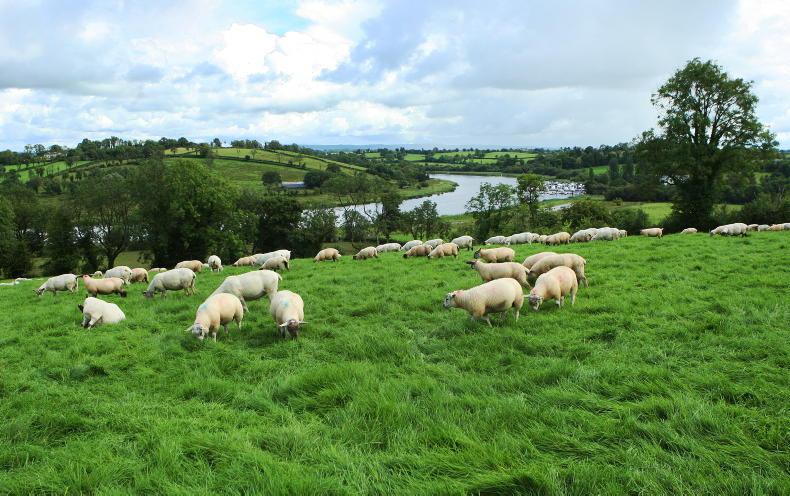
Taking stock: The start of September is a good point in time to take stock of important production milestones.
With regards lamb drafting, Teagasc targets for a mid-March lambing flock is to have 45% of lambs drafted by mid-August and 70% by mid-September. This figure includes ewe lambs selected for breeding for farms retaining their own replacements.
Hill flocks with a high percentage of improved or green grazing and which are possibly utilising crossbreeding in a percentage of the flock should have in excess of 80% of lambs weighing at least 25kg at the point of weaning, or approaching 30kg where weaning took place a few weeks ago. On harder hills and in flocks with a lower ewe mature weight, this could reduce to 60% to 70% of lambs weighing in excess of 25kg. A plan should be put in place on what to do with these lambs (see page 36/37).
To build sufficient grass supplies there should be 20 days grazing ahead of stock at the start of September, rising to 30 days by the end of the month. Steps should be taken to build covers where this is not the case.
It is important to review the body condition of breeding ewes regularly, and where applicable switch ewes from a maintenance to priority grouping where condition is lacking. As discussed last week it will take ewes four to five weeks on good-quality grass to gain half a condition score.
Grazing agreements: This week’s sheep feature on pages 36 and 37 discusses budgets for finishing store lambs. Short-term grazing agreements are also an option which some farmers may be more open to given potential tighter margins in purchasing stores.
It should be noted at the outset that where a farmer offering grazing is in receipt of support payments such as the Areas of Natural Constraint, they cannot relinquish control of lands. They can however enter in to a grazing agreement where they take in stock for grazing.
The requirement to notify the Department of Agriculture of sheep moved in such an agreement depends on the farm to which sheep are moving to and if there are livestock present.
The National Sheep Identification System (NSIS) rules state that where sheep are moving to a farm or land block where there are livestock already present then the Department must be notified. As there is no change in ownership, the onus lies with the owner of sheep to notify the Department.
However, if sheep move on to a farm with no stock present, or to a separate parcel of land to that which stock are retained on, then sheep can be moved to and from temporary grazing without notifying the Department.
TAMS deadline: Tranche eight of the Targeted Agricultural Modernisation Scheme will close for applications on Friday 5 September. For anyone planning on completing fencing works in 2026, now is the time to apply to be in a position to hopefully have approval in the first quarter of 2026.
There have been a few questions recently asking if mobile equipment can still be purchased once an application has been submitted and before approval has been received. This allowance is still in place, but it is worth considering that ranking and selection are now a feature of the approval process and therefore the risk of not receiving approval is at a higher level.




SHARING OPTIONS