


With grain price trends showing signs of a decrease, many farmers are now considering buying green barley/wheat off the combine and preserving it on the farm to feed to cattle during the winter.
Buying grain off the combine may seem like the makings of a cheap winter ration, but there are other factors that need to be taken into account, such as the cost of haulage, preserving the grain and storing it.
The first key question to ask yourself is: have you a facility on the farm to store the grain? There are a wide variety of methods of storing grain, from specialised stores to meal bins or even outside under plastic (crimped grain). Where grain is stored for use on the farm, farmers should ensure that the grain is not contaminated to reduce losses. Vermin can be a major issue with any animal feeds stored in yards. Standing grain silos often offer the best storage option in terms of lower losses and reduced possibility of the presence of vermin.
Where it is intended to store grain loose in sheds, then vermin proofing the shed is essential to avoid the possibility of disease spread and to reduce losses. Steps should be taken to vermin-proof the grain storage areas on the farm well before the arrival of any grain.
Options
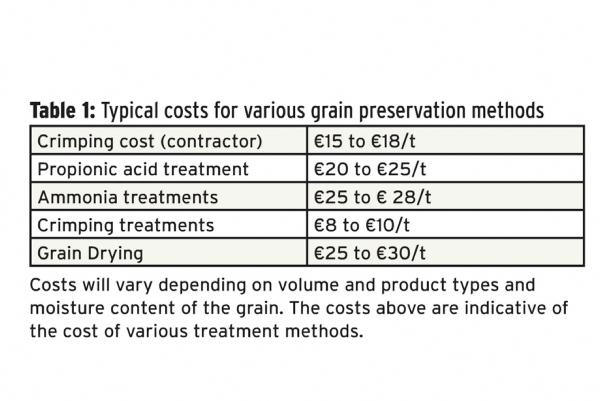
There are several different methods of grain preservation. For grain to be well preserved, it needs to be in a condition that will avoid the growth of bacteria, moulds or yeasts which may spoil the feed. Traditionally, grain that was intended for use as feed on the farm was dried to 15% moisture or lower to eliminate the possibility of spoilage. Once grain is dried to 15% moisture or less, then it can be preserved in its present state on the farm. The cost of drying grain will vary, depending on the efficiency of the drier and the starting moisture content of the grain. After drying, it is essential that grain is cooled to avoid the growth of moulds. Typically, it will cost €35 to €30/tonne to dry grain from 20% moisture to 15% moisture.
Propionic acid
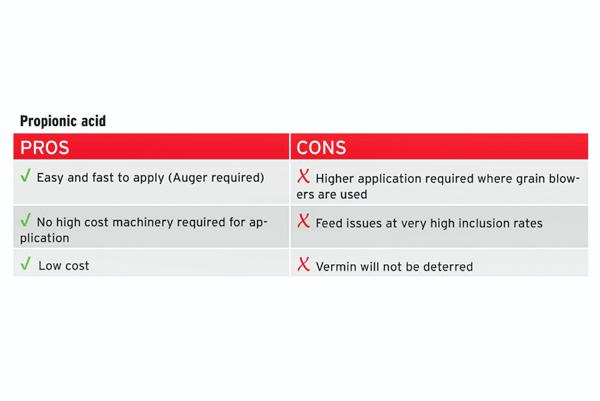
Due to its relatively low cost and ease of treatment, grain is often treated with propionic acid to preserve it. The acid acts by killing the bacteria and moulds which would naturally be present on the grain. By killing the bacteria and moulds, this allows the grain to be preserved safely, even at higher moisture levels.
It is essential that the correct mixture rates are adhered to. The cost of treatment with a propionic acid may vary, depending on the price of the product, etc, but in general, treatment will cost approximately €20 to €25/tonne.
UREA Treatment
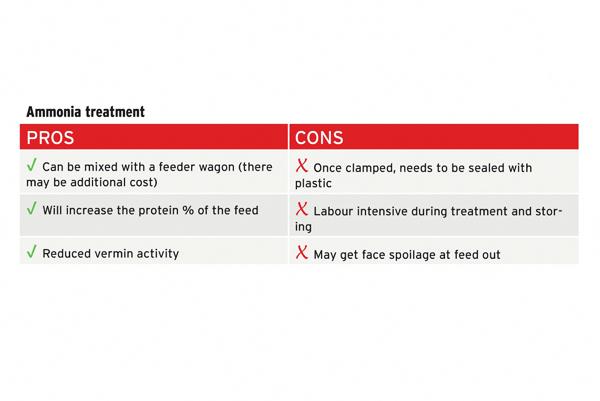
Urea treatment of grain as a means to preserving grain has increased in popularity in the last few years. The urea treatment works in a similar way to treating with propionic acid; it effectively sterilises the grain so that moulds, bacteria, mycotoxins, etc, are unable to grow and spoilage will not occur. There are various options available to farmers looking at ammonia treatments for grain. In the past few years, pellets have become more widely used. They need to be mixed at the specific rates, and accurately.
In many cases farmers tend to use feeder wagons to accurately mix the pellets with the grain before placing it in a pit. The clamp of grain should be covered with a good quality plastic sheet to hold the ammonia in the grain.
The added benefit of using an ammonia treatment is the fact that it will also help to increase the protein content of the feed. Each 10kg treatment with a product such as ‘Home ‘n’ Dry’ pellets will increase the protein content by 1.4%.
Crimped grain
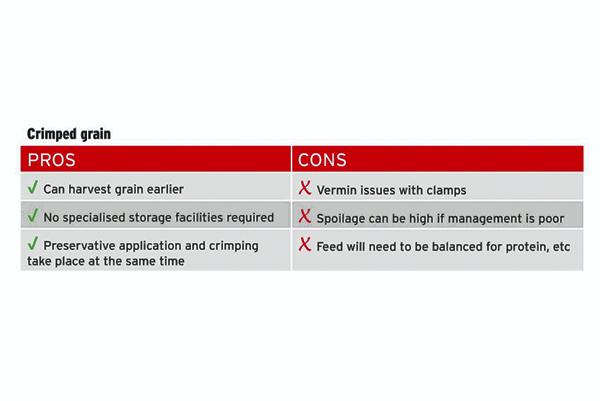
Ensiling crimped grain has the added advantage of conserving grain at a higher moisture content of 28% to 30% moisture. The grain is harvested before it is fully ripe and is passed through a crimper where it is crushed and an acid preservative applied to it.
The crimped grain can then be placed in a sealed silo or pitted and covered. Another advantage is that crimped grains can be clamped outdoors on concrete once they are covered correctly.



SHARING OPTIONS