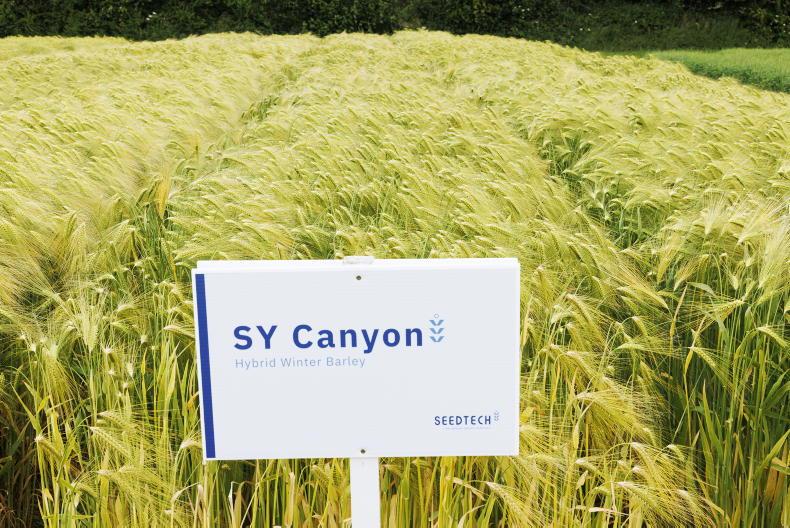
The 2026 winter barley recommended list has no new additions, but has seen Integral, Orcade and SY Canyon move from provisionally recommended to fully recommended since they were first listed last year. SY Armadillo is no longer on the list (see Table 1).
The Department of Agriculture publishes the recommended list each year based on its variety trials across the country over the past three years.
While there are no new additions for the season ahead, the list remains strong, with four of the eight varieties carrying barley yellow dwarf virus (BYDV) tolerance or resistance.
Half of the varieties are six-row (6R) and two of those are six-row hybrids (6RH).
The highest relative yield on the list is SY Canyon at 106, followed by Integral at 103. KWS Joyau and Orcade are both on 101.
The highest relative yield on the list is SY Canyon at 106
There is quite a bit of difference in straw height and straw strength. SY Canyon has a straw height of 103.3cm and Belfry is at 102.3cm. The shortest variety is KWS Tardis at 84.4.
SY Canyon, Molly and KWS Cassia fall down on resistance to lodging and straw breakdown. KWS Joyau tops the straw strength traits, followed by Belfry, Integral and KWS Tardis.
Disease resistance
Molly and SY Canyon have the best resistance to mildew, followed by Orcade. Belfry comes out on top for resistance to rhynchosporium with a score of eight, while KWS Tardis, Molly, Orcade and SY Canyon all rate a seven.
The majority of varieties rate a seven for resistance to net blotch, while Integral and SY Canyon are below this at six.
KWS Cassia is still grown for premium contracts, but its disease profile has fallen back. That said, it is a great variety for grain quality and is well liked, so once it is managed accordingly, growers should be fine.
There are no resistance scores for ramularia.
Grain quality
Screenings are generally on the low side for all varieties. Molly, Belfry, KWS Tardis and KWS Cassia are on the higher side of the measurements. Orcade has an exceptionally high thousand grain weight.
It is no surprise that KWS Cassia tops the list for hectolitre weight or KPH. It has a KPH of 68.5, closely followed by SY Canyon and Orcade.
Choosing a variety
There is great choice on this list and growers will have varieties they have come to like or want to try. If you grow a lot of winter barley, choose a mix of maturity ratings. KWS Joyau and Integral can come in very early. If you have three varieties aim to grow varieties with maturity ratings of eight, seven and six so crops are not all ready at the same time.
It is no surprise that KWS Cassia tops the list for hectolitre weight or KPH
If you are planting early, plant a BYDV-tolerant or resistant variety. You can leave the non-tolerant variety to later planting to spread risk.
There is just a small bit of seed on the market for a new variety Littoral to multiply it up (see Table 2).
Two percent of the seed is SY Craft for malting barley. Some growers get on well with this variety for malting. If you are planting a variety for malting this autumn, you need to have assurance that it will be purchased if it hits malting specifications.
This variety is not on the recommended list, so really it shouldn’t be grown on farms, but if it is, you need a price premium for it. At present, malting markets are shaky and there is not confirmation it will be wanted.
Are you going to plant winter barley?
All tillage farmers need to do the sums on how crops performed last year and decide what crops make most sense to grow and they have a market for.
Did the crop make a profit this year or will it after grain prices are finalised? Are you better to choose a different crop?
Of course, crop diversification requirements will hinder your ability to grow the crops you want and maximise your profit, so you may need to plant a crop or crops to fulfil requirements, even if this is not the best decision for profitability - which is ridiculous in a country like Ireland.
Many farmers do well with winter barley and find it profitable, so it will be an automatic slot there.
However, growers need to look at why some crops underperformed last year. A lot of winter barley crops suffered from take-all last year, as well as some BYDV.
Early sowing, a mild and wet winter and lack of slots after break crops did not help here and planting early was the sensible decision after two wet planting seasons.
Maximise BYDV-tolerant varieties and try to put winter barley in after a break crop or after wheat after a break crop.
Remember, demand for oats and rye is low so winter barley may be a better bet than those crops.