



The two storms that moved across the country this week thankfully passed without causing any damage or disruption on Tullamore Farm.
However, heavy rainfall has seen a vast deterioration in ground conditions in the last few days.
Speaking to farm manager Shaun Diver, he said: “There was heavy rainfall over Thursday night and into Friday morning. The storm was still passing over here at lunchtime on Friday."
In-lamb ewe lambs are the only stock at grass at the moment, with the plan to house them on the point of lambing in mid-March.
Grass utilisation up to this point has been excellent, but more waste is being seen this week. They are also getting 500g/day of ration.
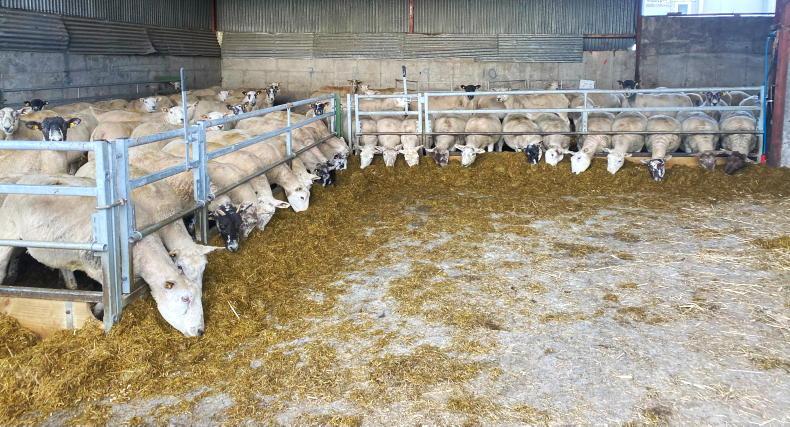
In the sheds, the twin-bearing mature ewes are currently being fed ration at a rate of 600g/day, while triplet-carrying ewes are on 700g/day. This will increase by 100g/day for both groups again next week.
By lambing, Shaun plans to have twin-bearing ewes on 800g/day, while triplet ewes will be on 1kg/day.
Ewes scanned carrying singles are not getting any concentrate feed and are being maintained with good-quality (75% DMD) baled silage that was made on farm from excess grazing.
Calving progress
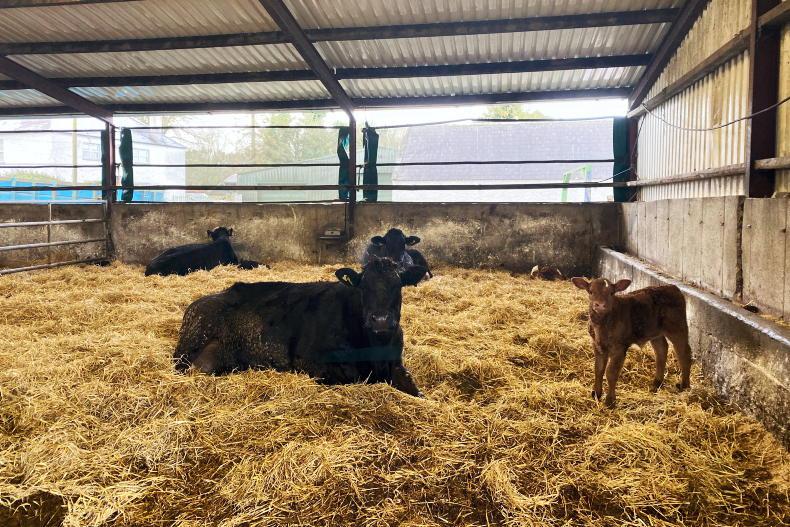
At this stage, 32 cows have calved and Shaun is describing progress as being "slow and steady", with no major glut of cows calving experienced as of yet.
“Calving is progressing nicely. There are a good few heifers with their time up over the next few days, but it has been steady up until now.
"With the way the weather is, I hope they continue to take their time as there won’t be anything getting to grass for the next week or 10 days.”
Housing space is not a concern as of yet, but if turnout is to be delayed for another fortnight, Shaun will have to look at creating a makeshift creep area for calves in one of the centre passages of the slatted shed.
This has worked well in previous years when weather conditions have become difficult.
Cow feed
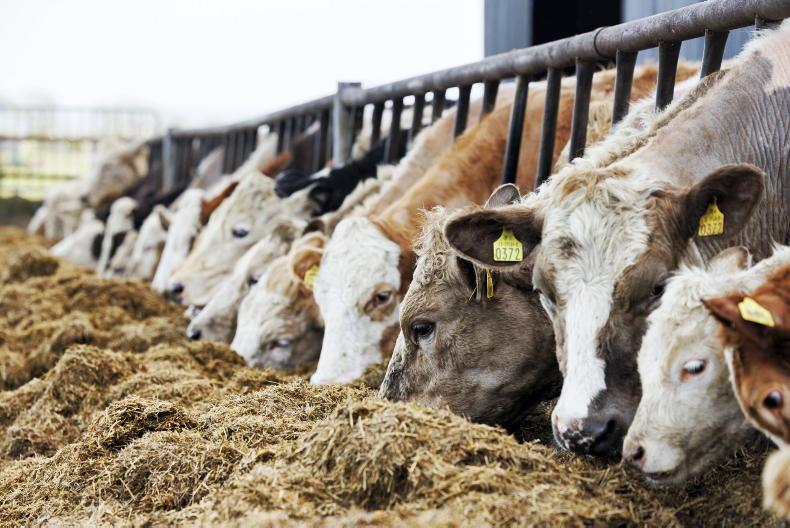
The cows are being fed 68% DMD silage and 300g/day of soya top-dressed on the silage, along with 180g/day of a pre-calving mineral.
Shaun explained the feeding regime: “Soya feeding has just been started in the last couple of weeks. Once I draft cows near calving off the slats down to the straw-bedded shed, they then move up to 500g/day of soya.
"I don’t want to feed them too much, as I feel it can lead to calves getting too big in the last few weeks of pregnancy.
"I am happy with calf size so far this year and, thankfully, we have only had to help a very small proportion of cows at calving up to now.”
Bull beef
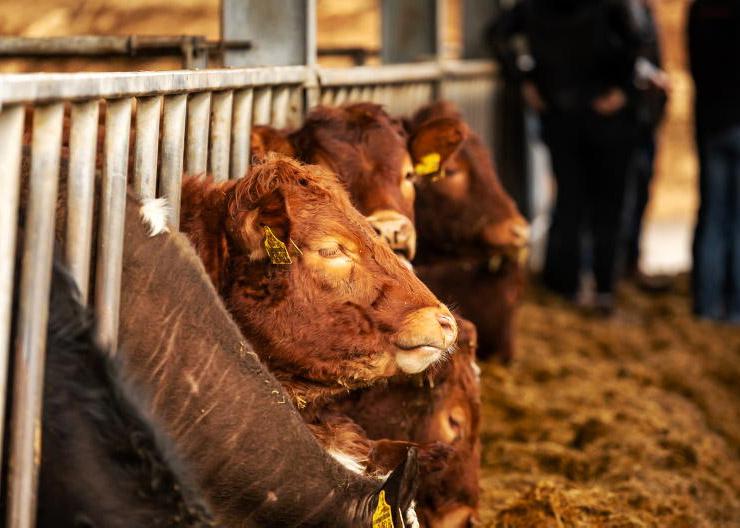
Last year’s bull calf crop are now up to 7.5kg/day concentrate, which is split into two feeds, morning and evening.
The ration is still a 16% protein weanling mix. However, in the coming weeks, Shaun plans to transition the bulls on to a 12% finishing ration.
“I will switch rations slowly over a number of days. I might start with the morning feed being the 16% ration and evening feed being the new one.
"Then after a few days phase out the 16% altogether, once we have used up whatever is left in the bin at that stage.
"Once on the new ration, we will continue to increase meal feeding levels every few days. I would plan to have them on ad-lib meal before St Patrick's Day."
Yearling heifers
Elsewhere, the yearling heifers have stopped getting concentrate at this stage in preparation for returning to grass. They will be the first group of stock to go out once conditions allow.
Over the winter, they were being fed 2kg/day of the same 16% protein ration as the young bulls. Removing meal feeding prior to turnout eases the animals' transition to a grass diet.



SHARING OPTIONS