


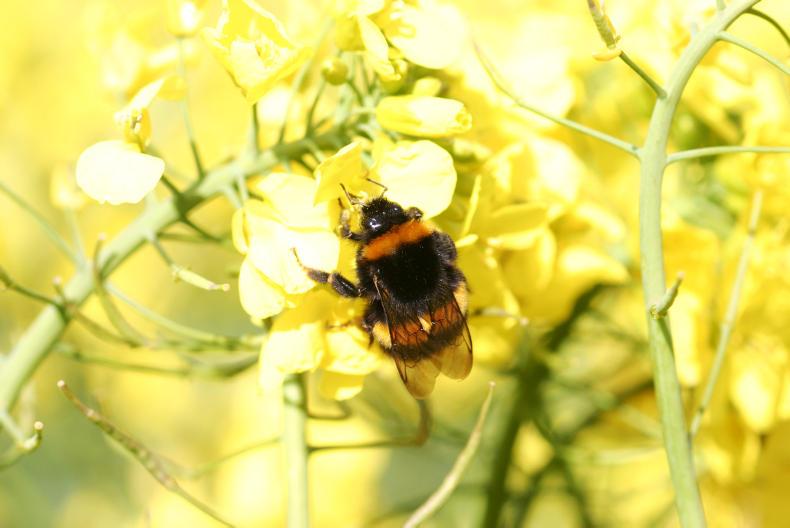
EU member states have voted to restrict the use of certain neonicotinoids, or neonics as they are also known, to applications in permanent greenhouses.
The decision will further reduce European farmers' ability to tackle pests, for many of which there are no alternative treatments available.
The vote focuses on banning outdoor use of the three active substances imidacloprid, clothianadin and thiamethoxam.
The use of neonicotinoids has been linked to the decline of honeybees, wild bees and other pollinators.
Speaking ahead of the vote, first vice president of the European Parliament, Mairead McGuinness, said: "Since 2013 there has been a moratorium on the use of three neonics – imidacloprid, clothianadin and thiamethoxam – on flowering crops that are attractive to bees, such as maize and oilseed rape.
"These neonicotinoids are currently used as seed dressings on winter cereals in Ireland.
"However, a study published by the European Food Safety Authority has led the Commission to consider the potential risk to wild pollinators and honey bees when they are on non-flowering crops," she said.
In light of the vote, the Commission will propose legislation to restrict the use of these three insecticides to controlled conditions inside greenhouses, according to McGuinness.
"As evidence evolves and a threat to bees is confirmed then action must follow. This will pose a challenge to cereal growers who depend on treated seed to prevent and control diseases and pests and will require that alternative tools are found for growers," she added.
Plenty of lovely bees at #Schuman today. ??
— Vytenis Andriukaitis (@V_Andriukaitis) April 27, 2018
Happy that Member States voted in favour of our proposal to further restrict the use of active substances #imidacloprid #clothianidin #thiamethoxam known as #neonicotinoids !
Vital for #Biodiversity #FoodProduction #Environment ?????? pic.twitter.com/gq76Z5biLo
The move represents a major extension of existing restrictions, which have been in place since 2013, when the Commission voted to severely restrict the use of plant protection products and treated seeds containing three of these neonicotinoids.
The first neonic was approved in the EU in 2005.
Neonics are systemic pesticides. Unlike contact pesticides, which remain on the surface of the treated leaves, systemic pesticides are taken up by the plant and transported throughout it.
Long read: getting the most from the minimum spend in crop protection




SHARING OPTIONS