



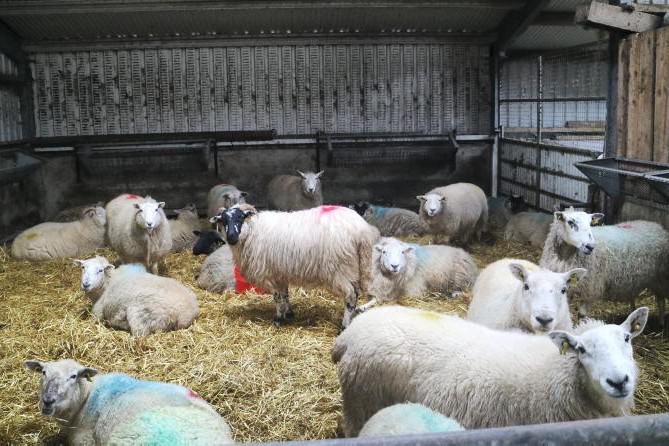
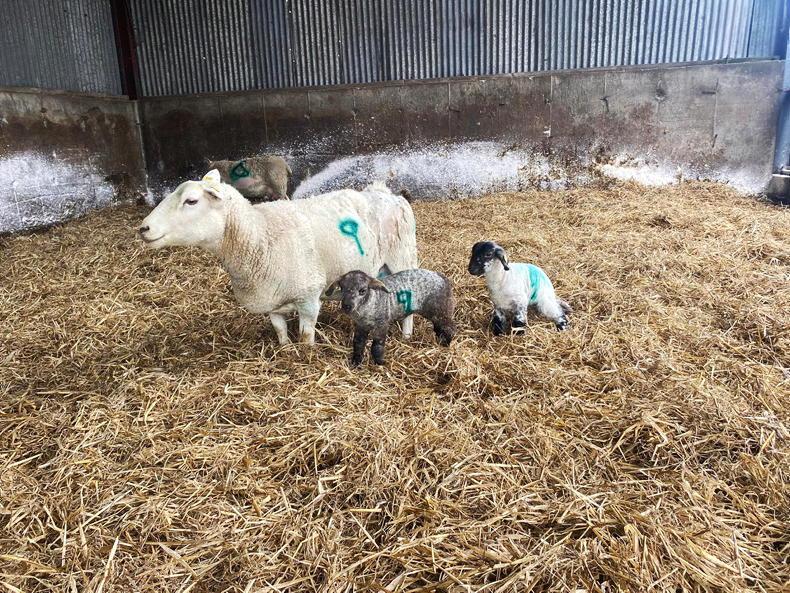
All about hygiene: lambing is set to ramp up over the next week with mid-season production systems in the final weeks of gestation.
With turnout remaining delayed and some farmers opting to try and hold sheep indoors to conserve grass supplies, hygiene is critical. Straw prices have crept up in recent years but it is still a lower cost investment relative to the alternative of disease establishing and potential mortality.
Applying lime to group pens and cleaning pens / disinfecting between sheep will help keep a lid on the build-up of bacteria. It is also important to recognise that during a busy period, failing to clean equipment, clothing etc can act as a reservoir of disease. Items such as stomach tubes, bottles etc need to be washed in warm soapy water and disinfected between uses.
Colostrum is also critical. If at all possible each lamb should receive colostrum from its ewe or a ewe on the farm with colostrum supplements used as a supplement and not as a substitute.
With regard turnout, in normal weather conditions and reasonably good levels of grass utilisation a plentiful supply of grass at a height of 4cm to 5cm upwards is more than capable of meeting nutritional demand of twin-suckling ewes in early lactation.
Where ewes are in poor body condition or grass utilisation, quality or supply is under pressure then ewes will benefit from short-term concentrate supplementation. A feeding rate of 0.3kg to 0.6kg will typically suffice for twin-suckling ewes with 0.3kg sufficient for single-suckling ewes.
Where grass supplies are scarce (less than 3.5cm) or if grass utilisation is particularly challenging/adverse weather conditions then supplementation rates will need to be increased.
The general recommendation is feeding rates of 0.7kg to 1kg for twin-suckling ewes in good body condition, rising to 1kg to 1.2kg for ewes lacking condition. An allocation of 0.3kg to 0.5kg will typically suffice for single-suckling ewes in good condition and 0.5kg to 0.7kg for ewes lacking condition.
Marketing avenues: a significant differential has opened up between prices offered between factories and also between the live and dead trade. Prices paid for top-quality hoggets in marts seem to be shading maximum prices offered by factories, particularly where there is vibrant wholesale and butcher buyer activity.
Higher commission rates in mart sales, ranging anywhere from €2.50 to upwards of €3 per head compared to less than a €1 per head in factories, also need to be taken into account along with the system that best suits time availability.
Producers with heavy hoggets on hand should also confirm potential cuts before sending sheep for slaughter with plants operating at a cut-off of 25kg or 27kg. It is also important to keep abreast of the trade with factories willing to pay significantly above quoted prices for large numbers.
Suitability for slaughter: the general rule for slaughter suitability is if animals are deemed unfit for transport then they are deemed unsuitable for slaughter. In this regard all animals presented must be able to walk unassisted and remain standing during transport.
Animals should never be presented for slaughter with an open wound, profuse bleeding or where there is a risk prolapsed organs can be easily damaged during transport. It is also prohibited to present pregnant females for slaughter that are 90% or more through their expected gestation.




SHARING OPTIONS