Profitability and sustainability are two of the major talking points in tillage at present. Margins are being squeezed tighter and tighter but farmers are still expected to undertake more actions and change their farming practices to protect the environment. Don Somers, winner of the Teagasc/FBD Environmental Sustainability Award for 2025, is one farmer trying to reduce the environmental impact of his farm whilst improving profitability simultaneously.
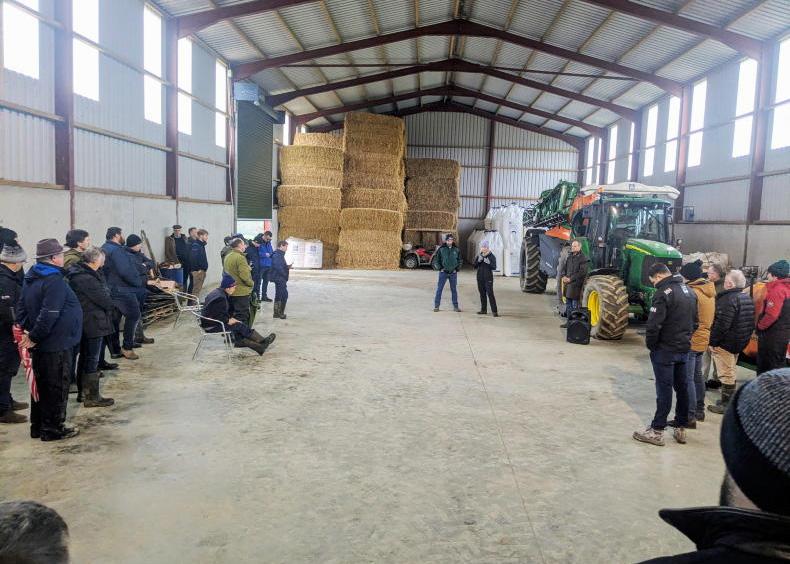
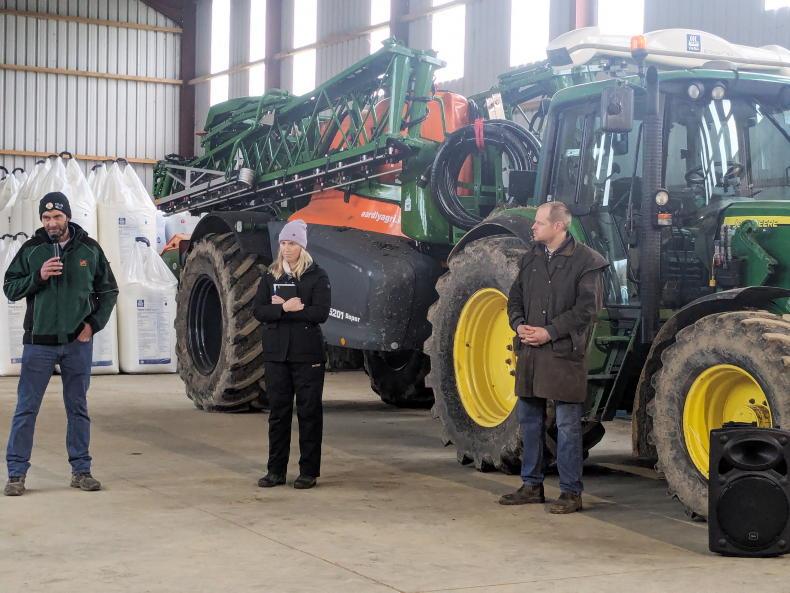
Don recently hosted a session at the Irish Tillage and Land Use Society’s spring workshop. Speaking to the crowd, he said: “We don’t sacrifice financial sustainability for environmental sustainability. Any action we take on the farm has to bring financial benefits to go with the environmental benefits.”
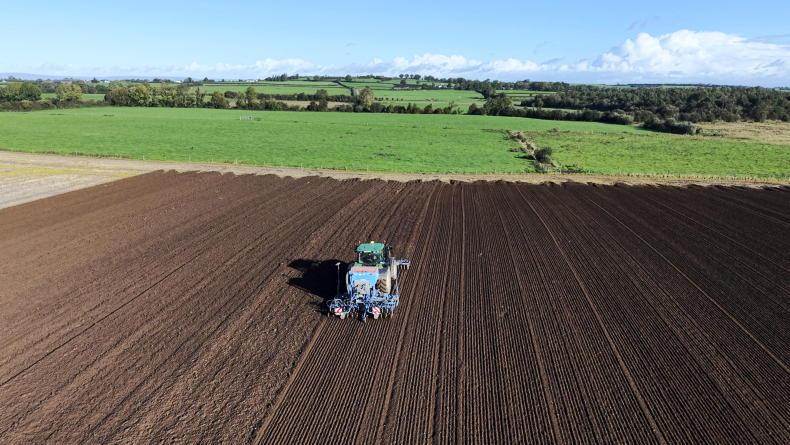
This message was made very clear throughout the visit to Don’s farm. Minimum tillage has been the main establishment system on the farm since 2017. Don explained that he couldn’t till his soils at the time.
The plough was turning up “big shiny sods” and it was taking a number of passes of disc harrows and power harrows to make a seedbed. Even then, the seedbed was never excellent.
He noted that it was not any individual action that led to an improvement in his soils.
A mixture of the switch to minimum tillage, straw chopping, cover cropping, using organic manures, a focus on compaction prevention and a more diverse crop rotation all helped to make Don’s soils “drastically better”.
Don warned that a plough and one-pass combination can lead to complacency. He acknowledged the many benefits of a plough but said that it allows farmers to plant crops into wetter soils and take full control of a field. While this often works to establish a crop, Don feels it will lead to issues down the line.
“Min-till forces you, whether you like it or not, to stay out of the field until it is fit to work. The soil conditions and the weather have more control and you have to accept that,” he said.
Don is a big advocate for using nutrients as efficiently as possible on farm, whether it is organic or artificial fertilisers. This begins with soil tests. Don has moved to taking soil samples based on yield maps generated by the yield monitor on his combine.
“When I had a number of years of yield maps, I started to see what was the yield potential of different parts of the field,” he said.
Rather than taking two samples in a field, one for the left half of the field and one for the right half, Don will now take two samples; one for the high-yielding areas, and one for the low-yielding areas.
These soil tests tell Don a lot about his land.
It may tell him that the poor yielding areas have a low pH or phosphorus (P) or potassium (K) levels. If this is not the case, he can delve deeper to see if compaction is an issue, if the area needs some organic manure to improve the organic matter, or perhaps the poor yields is down to soil type.
A Yara N-Sensor has also been used on the farm as part of a Teagasc trial.
This sensor, positioned on top of the tractor’s cab, detects the level of biomass a crop has and adjusts the fertiliser applied accordingly. Don has seen benefits to using it. It is especially helpful where organic manures have been applied as it can balance out any variability in the nitrogen levels of the manure.
In 2025, a winter wheat field trial on the farm showed that similar yields could be achieved with and without the N-Sensor.
The N-Sensor provided a saving of €8/ac on fertiliser. However, with the cost of using the N-Sensor reaching £7,000 per year, Don does not see this as a viable option for most farmers in Ireland.
However, he thinks that drone or satellite technology may play a bigger role in Ireland in the future to help create prescription maps that vary the amount of nitrogen applied to crops.
Don has dabbled with the use of liquid fertiliser since 2019.
The high level of accuracy is the biggest benefit he has seen, especially on headlands. There is no fertiliser thrown into the hedges and there is no under- or over-application on headland runs.
He also likes the flexibility it offers. He can choose to apply a urease inhibitor on the day of application by adding it to the sprayer tank if the weather conditions demand it. If they do not, he can continue without the urease inhibitor. Despite the benefits, liquid fertiliser has not worked logistically for Don but this may change.
Organic manures are widely used on the farm. Don explained how 50% of the nitrogen, 60% of the phosphorus, and 100% of the potassium requirements of spring barley is provided by poultry manure. Last year, this provided a fertiliser cost saving of €60/ac to Don and the yield of the crop was good too, at 3.2t/ac.
There is a similar story for spring beans, where 50% of the P and K requirement comes from farmyard manure.
Poultry manure was applied to the winter oilseed rape ground before planting last August. Don believes that the slow release of nutrients by the poultry manure is the reason why the crop had a GAI of 4.07 earlier this spring.
The GAI of his crop did not drop over the winter months like many oilseed rape crops generally do. This will allow Don to significantly reduce the amount of nitrogen applied this spring. The current plan is to apply 70kg N/ha in total.
Organic manures are treated in the exact same way as artificial fertilisers on the farm, and therefore testing the nutrient value of the organic manure is vital.
By doing this, Don knows exactly what nutrients he’s applying, allowing him to apply specific amounts depending on a field’s soil test results.
Compaction when spreading organic manures is also a concern. This is one of the reasons Don prefers poultry manure to slurry; it is much more nutrient dense and there is a lot less driving in the fields. The manure spreader and tractor are on low ground pressure tyres too.
Farmyard manure is not tipped in a field until the land is dry and the manure is spread just before sowing to reduce the potential for leaching.
A track machine is used to load the spreader as Don says a wheel loader would “destroy a whole part of the headland”.
Don realises that he is at risk of importing herbicide-resistant grassweeds onto his farm, especially with his use of organic manures and cover crop seed.
He always buys cover crop seed with the higher voluntary standard and tries to take farmyard manure from farmers he has sold straw to.
However, these practices only go so far and he cannot control what arrives in the poultry manure.
Don always chooses certified seed too after learning the hard way from using imported red-label bean seed in 2017.
“In the following crop in 2018, I found a small patch of a funny looking grass that looked a bit familiar. I got out my phone and found out it was blackgrass,” he explained.
The patch of blackgrass was only very small, measuring 5m by 5m. Don has been very strict with his management of this area since then.
Spring crops and break crops have been used frequently in the field and stale seedbeds are created after harvest. The patch is hand rogued three or four times before harvest every year, starting in May before the blackgrass sets seed.
Harvest 2025 was the first time since discovering the blackgrass that Don harvested the small area with his combine as he was absolutely sure there was no blackgrass in it.
However, he noted that he will remain extremely vigilant for many years as there is likely to still be blackgrass seeds in the soil.
“I have to constantly monitor it. If I slip up and the blackgrass goes through my combine and spreads all over my farm, tillage on my farm is finished,” Don warned.
Another interesting aspect of Don’s farm is his trialling of a pea/bean combi-crop over the past two years.
This is being done to help a local merchant replace imported soya and to create a 100% Irish ration.
The peas are planted at 40 to 50 plants/m2, while the aim is to have the beans at 15 to 20 plants/m2.
The idea of the mix is to have the beans act as a scaffolding for the peas to cling on to, reducing the risk of the peas lodging pre-harvest.
Beans were imported from Finland as a variety that ripens earlier was needed, even if this does come with a lower yield.
In 2024, this combination worked perfectly well until two weeks before harvest when the peas went flat to the ground. It took Don three days to harvest 17ac.
“I swore I’d never ever do this again. But when I looked at the figures after harvest, the pea/bean mix was my most profitable crop in 2024,” he explained.
Therefore, he tried it again last year. The pea variety was changed from Carrington to Ingrid which is more resistant to lodging. This time, the peas did not lodge. They did lean over but they stayed at a 45° angle and there were no issues whatsoever at harvest.
For the coming year, Don is trialling straight beans, straight peas and the pea/bean mix against each other to see how they stack up.
He noted that importing the seed costs €90/ac. He hopes that over time varieties will come available in Ireland to replace the imported seed and reduce costs.
Name: Don SomersFarm location: Oylegate, Co WexfordFarm Size: 180haSoil type: Sand to heavy clayEstablishment system: Minimum-tillageCrops: Winter oilseed rape, winter wheat, winter barley, winter oats, winter rye, spring barley, spring oats, spring beans, pea/bean combi-crop
Profitability and sustainability are two of the major talking points in tillage at present. Margins are being squeezed tighter and tighter but farmers are still expected to undertake more actions and change their farming practices to protect the environment. Don Somers, winner of the Teagasc/FBD Environmental Sustainability Award for 2025, is one farmer trying to reduce the environmental impact of his farm whilst improving profitability simultaneously.
Don recently hosted a session at the Irish Tillage and Land Use Society’s spring workshop. Speaking to the crowd, he said: “We don’t sacrifice financial sustainability for environmental sustainability. Any action we take on the farm has to bring financial benefits to go with the environmental benefits.”
This message was made very clear throughout the visit to Don’s farm. Minimum tillage has been the main establishment system on the farm since 2017. Don explained that he couldn’t till his soils at the time.
The plough was turning up “big shiny sods” and it was taking a number of passes of disc harrows and power harrows to make a seedbed. Even then, the seedbed was never excellent.
He noted that it was not any individual action that led to an improvement in his soils.
A mixture of the switch to minimum tillage, straw chopping, cover cropping, using organic manures, a focus on compaction prevention and a more diverse crop rotation all helped to make Don’s soils “drastically better”.
Don warned that a plough and one-pass combination can lead to complacency. He acknowledged the many benefits of a plough but said that it allows farmers to plant crops into wetter soils and take full control of a field. While this often works to establish a crop, Don feels it will lead to issues down the line.
“Min-till forces you, whether you like it or not, to stay out of the field until it is fit to work. The soil conditions and the weather have more control and you have to accept that,” he said.
Don is a big advocate for using nutrients as efficiently as possible on farm, whether it is organic or artificial fertilisers. This begins with soil tests. Don has moved to taking soil samples based on yield maps generated by the yield monitor on his combine.
“When I had a number of years of yield maps, I started to see what was the yield potential of different parts of the field,” he said.
Rather than taking two samples in a field, one for the left half of the field and one for the right half, Don will now take two samples; one for the high-yielding areas, and one for the low-yielding areas.
These soil tests tell Don a lot about his land.
It may tell him that the poor yielding areas have a low pH or phosphorus (P) or potassium (K) levels. If this is not the case, he can delve deeper to see if compaction is an issue, if the area needs some organic manure to improve the organic matter, or perhaps the poor yields is down to soil type.
A Yara N-Sensor has also been used on the farm as part of a Teagasc trial.
This sensor, positioned on top of the tractor’s cab, detects the level of biomass a crop has and adjusts the fertiliser applied accordingly. Don has seen benefits to using it. It is especially helpful where organic manures have been applied as it can balance out any variability in the nitrogen levels of the manure.
In 2025, a winter wheat field trial on the farm showed that similar yields could be achieved with and without the N-Sensor.
The N-Sensor provided a saving of €8/ac on fertiliser. However, with the cost of using the N-Sensor reaching £7,000 per year, Don does not see this as a viable option for most farmers in Ireland.
However, he thinks that drone or satellite technology may play a bigger role in Ireland in the future to help create prescription maps that vary the amount of nitrogen applied to crops.
Don has dabbled with the use of liquid fertiliser since 2019.
The high level of accuracy is the biggest benefit he has seen, especially on headlands. There is no fertiliser thrown into the hedges and there is no under- or over-application on headland runs.
He also likes the flexibility it offers. He can choose to apply a urease inhibitor on the day of application by adding it to the sprayer tank if the weather conditions demand it. If they do not, he can continue without the urease inhibitor. Despite the benefits, liquid fertiliser has not worked logistically for Don but this may change.
Organic manures are widely used on the farm. Don explained how 50% of the nitrogen, 60% of the phosphorus, and 100% of the potassium requirements of spring barley is provided by poultry manure. Last year, this provided a fertiliser cost saving of €60/ac to Don and the yield of the crop was good too, at 3.2t/ac.
There is a similar story for spring beans, where 50% of the P and K requirement comes from farmyard manure.
Poultry manure was applied to the winter oilseed rape ground before planting last August. Don believes that the slow release of nutrients by the poultry manure is the reason why the crop had a GAI of 4.07 earlier this spring.
The GAI of his crop did not drop over the winter months like many oilseed rape crops generally do. This will allow Don to significantly reduce the amount of nitrogen applied this spring. The current plan is to apply 70kg N/ha in total.
Organic manures are treated in the exact same way as artificial fertilisers on the farm, and therefore testing the nutrient value of the organic manure is vital.
By doing this, Don knows exactly what nutrients he’s applying, allowing him to apply specific amounts depending on a field’s soil test results.
Compaction when spreading organic manures is also a concern. This is one of the reasons Don prefers poultry manure to slurry; it is much more nutrient dense and there is a lot less driving in the fields. The manure spreader and tractor are on low ground pressure tyres too.
Farmyard manure is not tipped in a field until the land is dry and the manure is spread just before sowing to reduce the potential for leaching.
A track machine is used to load the spreader as Don says a wheel loader would “destroy a whole part of the headland”.
Don realises that he is at risk of importing herbicide-resistant grassweeds onto his farm, especially with his use of organic manures and cover crop seed.
He always buys cover crop seed with the higher voluntary standard and tries to take farmyard manure from farmers he has sold straw to.
However, these practices only go so far and he cannot control what arrives in the poultry manure.
Don always chooses certified seed too after learning the hard way from using imported red-label bean seed in 2017.
“In the following crop in 2018, I found a small patch of a funny looking grass that looked a bit familiar. I got out my phone and found out it was blackgrass,” he explained.
The patch of blackgrass was only very small, measuring 5m by 5m. Don has been very strict with his management of this area since then.
Spring crops and break crops have been used frequently in the field and stale seedbeds are created after harvest. The patch is hand rogued three or four times before harvest every year, starting in May before the blackgrass sets seed.
Harvest 2025 was the first time since discovering the blackgrass that Don harvested the small area with his combine as he was absolutely sure there was no blackgrass in it.
However, he noted that he will remain extremely vigilant for many years as there is likely to still be blackgrass seeds in the soil.
“I have to constantly monitor it. If I slip up and the blackgrass goes through my combine and spreads all over my farm, tillage on my farm is finished,” Don warned.
Another interesting aspect of Don’s farm is his trialling of a pea/bean combi-crop over the past two years.
This is being done to help a local merchant replace imported soya and to create a 100% Irish ration.
The peas are planted at 40 to 50 plants/m2, while the aim is to have the beans at 15 to 20 plants/m2.
The idea of the mix is to have the beans act as a scaffolding for the peas to cling on to, reducing the risk of the peas lodging pre-harvest.
Beans were imported from Finland as a variety that ripens earlier was needed, even if this does come with a lower yield.
In 2024, this combination worked perfectly well until two weeks before harvest when the peas went flat to the ground. It took Don three days to harvest 17ac.
“I swore I’d never ever do this again. But when I looked at the figures after harvest, the pea/bean mix was my most profitable crop in 2024,” he explained.
Therefore, he tried it again last year. The pea variety was changed from Carrington to Ingrid which is more resistant to lodging. This time, the peas did not lodge. They did lean over but they stayed at a 45° angle and there were no issues whatsoever at harvest.
For the coming year, Don is trialling straight beans, straight peas and the pea/bean mix against each other to see how they stack up.
He noted that importing the seed costs €90/ac. He hopes that over time varieties will come available in Ireland to replace the imported seed and reduce costs.
Name: Don SomersFarm location: Oylegate, Co WexfordFarm Size: 180haSoil type: Sand to heavy clayEstablishment system: Minimum-tillageCrops: Winter oilseed rape, winter wheat, winter barley, winter oats, winter rye, spring barley, spring oats, spring beans, pea/bean combi-crop
SHARING OPTIONS